
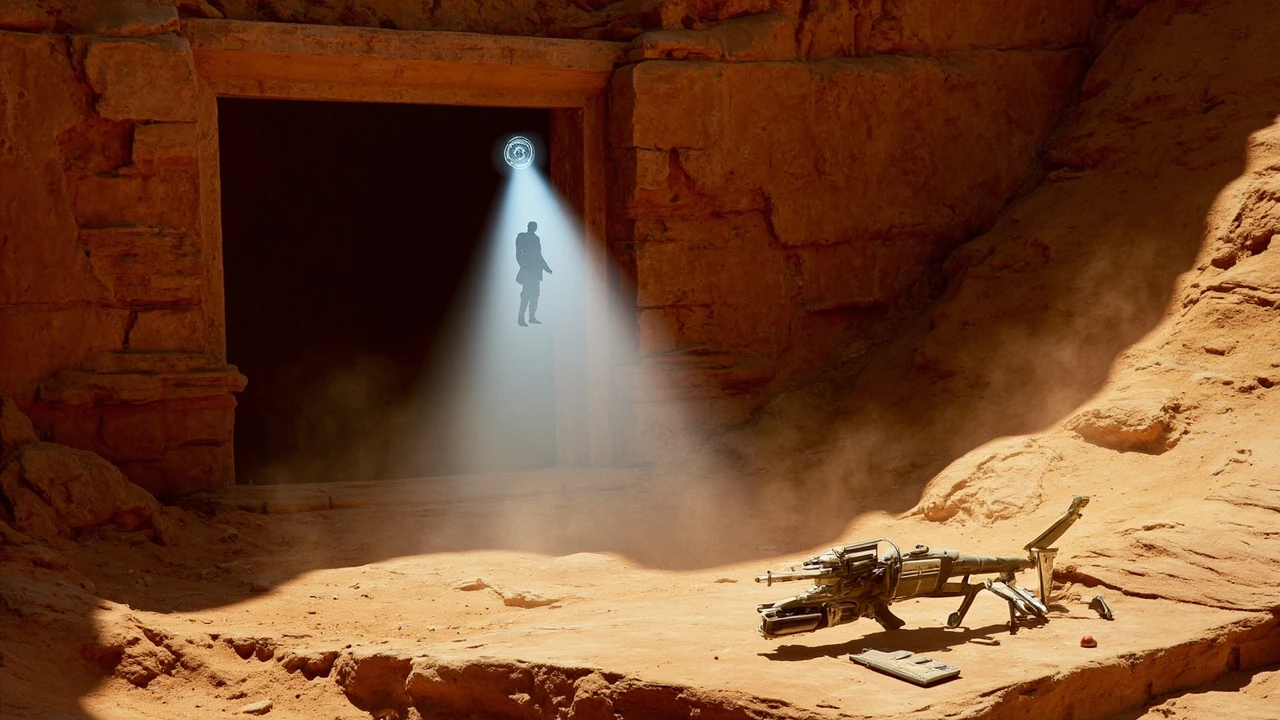
Jet kordos legacy: a long vault chain that turned open-world design into a treasure hunt
A vault chain that spans four planets, eight quest steps, and a custom piece of in-fiction hardware is not a side activity. Jet Kordo’s Legacy in Star Wars Outlaws is one of the larger optional quest arcs shipped with the base game, and it is also one of the clearer examples of how Massive Entertainment designed the open world to support long-form exploration without forcing a single path. For developers, the chain reads as a case study in how a quest arc can function as a tutorial, a navigation system, and a reward track at the same time.
This article looks at the jet kordos legacy arc from a game development and game design angle. It traces the actual structure of the chain, the role of the Holotracker as an in-fiction GPS, the gating mechanics that pull the player across Toshara, Kijimi, Akiva, and Tatooine, the reward economy built around the Scoundrel set and related items, and the design decisions a producer or systems designer would want to study. Where the article references mechanics, it works only from verified information about the chain; where it goes into design interpretation, it is clearly marked as editorial reasoning.
Players who have not yet started the chain will find a structural map of what to expect. Developers reading for craft will find a breakdown of how a single item, the Holotracker, is asked to carry a multi-planet quest arc and what makes that kind of design work.
What jet kordos legacy actually is in Star Wars Outlaws
Jet Kordo’s Legacy is a long chain of optional quests that takes Kay Vess across all four open-world planets in Star Wars Outlaws: Toshara, Kijimi, Akiva, and Tatooine. The arc centers on finding hidden vaults connected to the smuggler Jet Kordo, an Ugnaught whose story is told through recordings left inside each vault. The chain begins on Toshara after the main story quest “The Wreck” is completed, and progress is tracked in the Outlaw Legends tab of the in-game Journal.
From a structural point of view, the arc is best understood as eight quest steps. The first vault is a single, on-rails introduction on Toshara that also doubles as the player’s first exposure to the Holotracker, the in-fiction tool used to locate Smuggler Caches and the Jet Kordo vaults themselves. After that opening vault, the order across Kijimi, Akiva, and Tatooine is open: the main quest of the base game gives the player freedom to visit any of the other planets in any sequence, and the developers chose not to lock the remaining vault steps to a fixed order.
From a production perspective this is a meaningful choice. A long, multi-planet chain could have been gated as a single sequence, but shipping it as a free-order arc after the first step means the quest system has to tolerate the player showing up out of order, in different states of story progress, and with different unlocks on each planet. That tolerance is built into how the quest flags, hints, and Holotracker data are written.
The Holotracker as a design system
The single most important production asset in the jet kordos legacy arc is the Holotracker. After the Toshara story quest “The Wreck” is complete and Kay has reunited with ND-5, the Holotracker can be found near the blaster workbench and a side door on the Trailblazer. The device shows a marked location on the current planet and is used to drive both the Jet Kordo chain and the broader Smuggler Cache system.
At first the device only displays a single hologram, pointing to a spot on Toshara. That is intentional: the first vault sits near a homestead behind Typhon’s Rock in the Lost Steppe region, with Jaunta’s Hope to the northwest, Pyke Territory to the southwest, and the Shipjacker Workshop to the east. The Holotracker teaches the player how to read it during the first vault, and from that point on the same interface carries the rest of the chain.
For a systems designer, the Holotracker is a small object doing a large amount of work. It serves as a tutorial device, a navigation aid, a quest progression tracker, and a connective tissue between the Jet Kordo chain and the wider Smuggler Caches. The lesson is that when a game world has many optional locations, giving the player a small, in-fiction, reusable tool is often cheaper and more readable than scripting each discovery with bespoke UI or waypoint chains.
Quest structure across the four planets
Although the on-disk quest IDs run as a single chain, the playable order is open once Toshara is done. ND-5 suggests Kijimi next, and following that suggestion is the cleanest path, but the game does not enforce it. Each planet introduces a different gating requirement, which is itself a deliberate pacing decision.
Toshara: the on-ramp
Toshara is where the chain starts and where the Holotracker is introduced. The first vault is essentially linear, and its design lesson is that the player’s first exposure to a multi-planet system should be the most guided step. The Lost Steppe location sits near named landmarks, which gives the player readable environmental cues before the Holotracker hologram is even consulted.
Kijimi: leads through overheard conversation
The Kijimi step is driven by a lead obtained by listening to two citizens on a bridge east of the Crimson Dawn district’s fast-travel point: a Sullustan and a Mon Calamari. Their conversation mentions the Miyuki Trade League, and the Sullustan directs Kay to the Thieves District square. The structure here is lead, follow, and resolve, with the lead acquired through an overheard dialogue rather than a map marker. From a quest-writing angle, that means the step requires a small ambient event to be live when the player arrives, and for the AI loop and audio to handle that correctly under open-world conditions.
Akiva: the gating quest
Akiva is the most gated step in the chain. To find the first vault there, the player must unlock the Hydrorepulsor, the speeder upgrade that lets the Trailblazer’s bike drive over deep water. That upgrade is gated behind progressing the main story on Akiva and completing the Expert quest “The Scavenger.” Once unlocked, the player finds the first lead by locating two aliens chatting at a fountain in Artisan’s Row in Myrra, Akiva’s capital.
Akiva also has a second vault, the Overgrown Vault, and a second lead that requires eavesdropping on a couple talking in front of the gates to Hutt Territory in Myrra. The interesting production detail is that both Akiva vault quests reuse the same city and the same general NPC pattern, but they escalate from a fountain to a territory gate, which is a clear signal that the designers wanted vertical escalation without a heavy new tutorial.
Tatooine: free-form leads in Mos Eisley
On Tatooine, the lead for the first vault, the Buried Vault, comes from finding a couple of NPCs in Mos Eisley. The published guide notes that these NPCs may be in a different spot, which is a small but useful signal for level designers: this quest is not fully pinned, and the system tolerates the NPCs moving within a small area. After the Buried Vault is explored, Kay and ND-5 do not need to start from scratch; ND-5 picks up a lead on the second vault, the Perched Vault, and the chain continues without resetting progress.
Toshara again: the closing vault
Once the vaults on the other planets are cleared, the chain returns to Toshara for a final vault. The design logic here is straightforward: returning to the planet where the chain started lets the quest bookend itself, and it lets the closing reward be staged on the same map where the player first learned the Holotracker.
Order, gating, and the design intent behind the open sequence
On paper, jet kordos legacy looks like a sequence. In practice, the on-disk sequence and the playable sequence are different things, and the developers used that gap deliberately. After the first Toshara vault, the chain has no required order. The player can complete the vaults on Kijimi, Akiva, and Tatooine in any sequence, and the chain will still resolve, because each step only depends on local unlocks, not on a global flag set by a specific other planet’s vault.
This produces a small but important design property: progress is recoverable. If a player picks up the chain late, the system does not need to backfill the missing planets with content. The story still makes sense because each vault’s recording is tied to that specific vault, and the chain’s emotional resolution sits at the final Toshara vault, not at any planet in the middle.
The cost of that flexibility is more authoring work per planet. Each planet’s step has to be plausible as both a “first” and a “last” vault in the player’s run, which means the hints, NPC dialogue, and Holotracker markers have to be written so they do not assume a particular order. That is a known pattern in long optional chains, but it is worth naming explicitly. According to the walkthrough at Vulkk’s vault guide, the chain is documented as an open-order arc after Toshara precisely because each planet’s step is self-contained.
Rewards and the Scoundrel set
Across the eight parts of the chain, the player collects a coherent set of rewards. These include a full clothing set with a Set Bonus, a paint job for the speeder, a Major Charm, and a Shift Token for the in-fiction card game Kessel Sabacc. The chain is also the source of the trail of recordings that tell Jet Kordo’s story.
The most discussed reward is the Scoundrel set itself. The set uses earth tones with gold accents and is intentionally designed to read as a classic smuggler look rather than a faction uniform. Critically, the set’s effects and Set Bonus are described in production notes as well-rounded and versatile, rather than a narrow buff on a single tool. That decision is meaningful: a set that supports multiple play styles is easier to slot into a player’s existing build, which keeps the reward feel fair across the player base.
Less discussed but equally important is what the chain does not give. There is no Blaster Coating, no Nix Accessory, no Trinket, and no Speeder Trophy in the Jet Kordo vaults, even though there are enough vaults to support such drops. There are also no Trailblazer customizations from the chain, on the assumption that the default Trailblazer customization reflects what the ship looked like when Jet owned it. That is a deliberate restraint: not every long chain needs to fill every cosmetic slot, and the developers left headroom for the DLC to add a new system, the Adaptive Generators, through a short follow-up quest.
Reward inventory at a glance
| Reward | Type | Slot or system | Notes |
|---|---|---|---|
| Scoundrel clothing set | Outfit with Set Bonus | Clothing (head, chest, pants) | Earth tones with gold accents, versatile effects |
| Sandcrawler Speeder Paint Job | Vehicle cosmetic | Speeder paint | Name drawn from Jawas’ preferred transport |
| Cocktail Umbrella | Major Charm | Charm slot | Activates a Set Bonus with 2 of 3 pieces equipped |
| Direct Transaction | Shift Token | Kessel Sabacc | Trade hand to another player on the last turn |
| Eight recordings | Narrative collectible | Journal, Outlaw Legends tab | Tell Jet Kordo’s story as a Ugnaught smuggler |
| Blaster Coating, Nix Accessory, Trinket, Speeder Trophy | Not included | N/A | Chain deliberately leaves these slots open |
The Cocktail Umbrella charm and a small balance lesson
The Cocktail Umbrella deserves a closer look because it illustrates how a Major Charm slot can quietly shape build identity. The charm’s effect is to grant a Set Bonus when only two of three set pieces are equipped. In theory, that opens up build flexibility. In practice, because the strongest set effects already come from full three-piece bonuses, and because most duplicate effects sit on the same clothing slot, the charm is widely seen as a weak payoff for a Major Charm slot. The published opinion is that the Cocktail Umbrella would only be worth equipping if it were a Minor Charm, not a Major one.
For systems designers, the lesson is that slot rarity and effect strength need to match. A charm in a Major slot needs to compete with the strongest charms in the game, and “use a Set Bonus with two pieces” is not competitive against a strong build-defining charm at the same tier. The chain is a good place to ship a Major Charm because the player is heavily invested by the eighth vault, but the charm’s tier has to match the rest of the Major Charm catalog or the reward feels under-tuned.
Direct Transaction and the Sabacc economy
The Direct Transaction is a Shift Token in Kessel Sabacc that lets a player trade their hand to another player or NPC opponent on the last turn of a round. In the right setup, this can effectively guarantee a win: build the worst hand possible, use Nix to identify the opponent with the best hand, and trade into that hand at the last turn. The token is one of the strongest Shift Tokens in the game, and the jet kordos legacy chain is the source of the Direct Transaction in the player’s collection if it is unique to this quest line.
From a balance perspective, that is healthy. A long optional quest delivering one of the strongest Sabacc tokens gives late-game players a reason to keep playing the card game, and it does not break the broader economy because Sabacc is contained to its own mode. The relevant production decision is that the token is opt-in: a player who never touches Sabacc loses almost nothing, while a player who enjoys the game gets a meaningful reward for finishing the chain.
DLC continuation and the Adaptive Generators
For players who own the “A Pirate’s Fortune” DLC or the Season Pass, completing the base-game Jet Kordo quests unlocks a short optional follow-up. That follow-up grants the Adaptive Generators, a new Passive System for the Trailblazer introduced with the DLC. The trigger is simple: travel to Hauler’s Keep in the Khepi System and speak to an NPC near the Trailblazer’s ramp in the hangar. That NPC sends the player to Jet Kordo’s Hideout, a marked location in Toshara’s Lost Steppe.
The design move here is clean. The base-game chain establishes Jet Kordo as a character and the Trailblazer as his former ship. The DLC then uses that narrative to justify a new upgrade system on the same ship, with the same NPC infrastructure and the same general location logic. The player does not have to relearn anything, and the developers do not have to build a new gating system. This is a low-cost continuation that is enabled almost entirely by the base game’s narrative groundwork.
How the chain compares to other open-world quest arcs
Within Star Wars Outlaws, jet kordos legacy is one of the longer optional chains, but it is not the only one. Smuggler Caches share the same Holotracker interface, and each planet has its own catalog of cache locations. From a navigation standpoint, the chain and the caches are the same system; from a narrative standpoint, the chain is unique in that it produces a coherent story across all four planets.
For developers, the comparison worth making is not between the chain and the caches but between the chain and similar multi-region quest arcs in other open-world games. The key pattern to note is the use of an in-fiction, reusable device to drive the entire arc. The Holotracker is the player-facing face of the system, but the underlying quest, audio, NPC, and location logic are organized around that one object. The production cost of building a chain that uses a single shared device is lower than building eight bespoke quest steps, and the player-facing cognitive load is also lower, because the player only has to learn one interface.
Structural comparison of the chain’s gates
| Planet | Quest step | Primary gate | Lead source |
|---|---|---|---|
| Toshara | First vault | Complete “The Wreck” main story quest | Holotracker hologram near Typhon’s Rock |
| Kijimi | Vault step | Free travel after first vault | Overheard conversation on a bridge in Crimson Dawn district |
| Akiva (vault 1) | Vault step | Hydrorepulsor unlock via Akiva main story and “The Scavenger” Expert quest | Two aliens at a fountain in Artisan’s Row, Myrra |
| Akiva (vault 2) | Overgrown Vault | First Akiva vault complete | Eavesdropping near Hutt Territory gates in Myrra |
| Tatooine (vault 1) | Buried Vault | Free travel after first vault | NPC couple in Mos Eisley |
| Tatooine (vault 2) | Perched Vault | Buried Vault complete | ND-5 lead, no fresh investigation required |
| Toshara | Final vault | All other planet vaults complete | Return to the original vault area |
| DLC follow-up | Adaptive Generators | Base chain complete and DLC ownership | NPC at Hauler’s Keep, Khepi System |
Designing the quest around the player’s pace
Jet kordos legacy is built for a player who does not want to sprint the chain. The decision to allow free ordering after Toshara means the player can slot each vault between main story missions, between Smuggler Cache hunts, or between other contracts. The story still works because each vault is locally coherent and the recording at each vault is self-contained.
That kind of pacing flexibility is more difficult to build than a single locked sequence, but it is also what allows the chain to live alongside a longer open-world game without feeling like it has to be completed in one sitting. For developers working on similar chains, the practical lessons are: keep each step’s narrative locally complete, use a small in-fiction device to drive the whole arc, and design the final step so it can be the last regardless of the order in which the others were done.
Production and content-pipeline considerations
From a production standpoint, the chain has several characteristics worth noting. The quests rely heavily on discovering hints, using intel, and following leads. That is a deliberate departure from map-marker-driven quest design, and it implies more dialogue authoring, more ambient NPC audio, and more investigation logic than a typical “go to the marker” quest.
There is also a real cost in keeping the Holotracker system coherent across Smuggler Caches, the jet kordos legacy chain, and any future content that uses the same interface. Each new entry in that system touches the device’s data model, the journal UI, the Outlaw Legends tab, and the planet-level location logic. A useful internal check before shipping such a chain is to verify that adding a new vault step does not require changes to the other vaults’ data, because if it does, the chain’s flexibility will start to rot.
What jet kordos legacy teaches about long optional arcs
The chain is a useful reference for any team designing a long, multi-region optional quest. It demonstrates several design patterns that hold up under scrutiny: one reusable in-fiction device carries the whole arc, a single guided first step teaches the system, free ordering after the first step respects the player’s open-world pace, rewards are coherent and well-themed but do not fill every slot, and a DLC follow-up reuses the chain’s narrative and location infrastructure to introduce a new system.
The chain is not a perfect blueprint. The Cocktail Umbrella’s Major Charm tier is a clear example of a reward that did not match its slot’s power level, and the lack of Trailblazer customizations from the chain itself is a small but visible gap. Both of those are useful negative examples: the first is a balance lesson about matching reward tier to slot tier, and the second is a content-budgeting lesson about not promising every cosmetic category on every chain.
How to start the chain as a player
For a player who has just finished the Toshara main story quest “The Wreck” and met ND-5 back on the Trailblazer, the chain starts at the Holotracker. The device is on the ship near the blaster workbench and a side door. Pick it up, follow the hologram to the Lost Steppe area behind Typhon’s Rock, and explore the first vault. After that, the chain opens up, and the remaining vaults can be tackled in any order across Kijimi, Akiva, and Tatooine, returning to Toshara for the final vault once the others are complete.
Players who plan to do the DLC should complete the base-game chain before starting “A Pirate’s Fortune,” because the Adaptive Generators follow-up is gated behind finishing the base arc. For developers, that gating is a useful reminder: a small follow-up quest, properly gated, is a low-cost way to bridge a base-game chain into a paid expansion without breaking either piece of content.
Frequently asked questions
How many vaults are in jet kordos legacy?
The chain runs as an eight-part saga across all four open-world planets. There is one vault on Toshara, two on Kijimi, two on Akiva, two on Tatooine, and a final vault that returns to Toshara after the others are complete. The exact count per planet is not always pinned to a single on-disk step, because the quest is written as a free-order arc after the opening vault.
Do I have to do the vaults in a specific order?
No. After the first vault on Toshara, the chain does not require a fixed order. The recommended path is Kijimi next, then Akiva, then Tatooine, then back to Toshara, but the main story of the base game lets the player travel between planets freely. The chain is written so that each step only depends on local unlocks, not on a global flag set by a specific other planet.
What unlocks the Akiva vaults?
To reach the first Akiva vault, the player must unlock the Hydrorepulsor, the speeder upgrade that lets the bike drive over deep water. That upgrade is gated behind progressing the Akiva main story and completing the Expert quest “The Scavenger.” Once the Hydrorepulsor is unlocked, the lead for the first vault comes from two aliens chatting at a fountain in Artisan’s Row in Myrra.
What rewards come from completing jet kordos legacy?
The chain grants the Scoundrel clothing set with a Set Bonus, the Sandcrawler Speeder Paint Job, the Cocktail Umbrella Major Charm, the Direct Transaction Shift Token for Kessel Sabacc, and the eight recordings that make up the narrative of Jet Kordo’s heist. The chain does not grant a Blaster Coating, a Nix Accessory, a Trinket, a Speeder Trophy, or any Trailblazer customization.
What does the Cocktail Umbrella charm do?
The Cocktail Umbrella is a Major Charm that lets a Set Bonus take effect when only two of three set pieces are equipped. In practice, because the strongest Set Bonuses are designed to be used with all three pieces and duplicates usually land on the same clothing slot, the charm is widely seen as a weak payoff for a Major Charm slot. It would feel fairer at the Minor Charm tier.
Is the Direct Transaction Shift Token useful in Sabacc?
Yes. The Direct Transaction is one of the strongest Shift Tokens in Kessel Sabacc. It lets a player trade their hand to an opponent on the last turn of a round, which can effectively guarantee a win if the player has already identified the opponent with the best hand. It is the kind of token that only matters if the player actively plays Sabacc, which keeps the reward from breaking the broader game economy.
How does the DLC add to jet kordos legacy?
If the player owns the “A Pirate’s Fortune” DLC or the Season Pass and has completed the base-game chain, a short optional follow-up unlocks the Adaptive Generators, a new Passive System for the Trailblazer. The trigger is a conversation with an NPC at Hauler’s Keep in the Khepi System, near the Trailblazer’s ramp, who sends the player to Jet Kordo’s Hideout on Toshara.
Where do I find the Holotracker?
The Holotracker is on the Trailblazer, near the blaster workbench and a side door. It becomes available after the Toshara main story quest “The Wreck” is complete and Kay has met ND-5 back on the ship. The same device is also used to locate Smuggler Caches across all four planets, so it has a life outside the Jet Kordo chain.
Is jet kordos legacy required for the main story?
No. The chain is fully optional. The main story of Star Wars Outlaws does not depend on completing any Jet Kordo vault, and the chain can be started, paused, and resumed at the player’s pace. The only practical gate is the Holotracker itself, which is unlocked after “The Wreck” on Toshara.
What design lessons does jet kordos legacy offer developers?
Three lessons stand out. First, a small in-fiction reusable device like the Holotracker can carry a long quest arc and keep authoring costs manageable. Second, free ordering after an on-rails first step lets the chain respect the player’s open-world pace without breaking narrative coherence. Third, reward tier and slot tier need to match: the Cocktail Umbrella’s Major Charm placement is a clear example of a reward that under-delivered for its slot, and the chain’s restraint on cosmetic categories is a useful counter-example of a chain that did not over-promise.



Leave a Reply