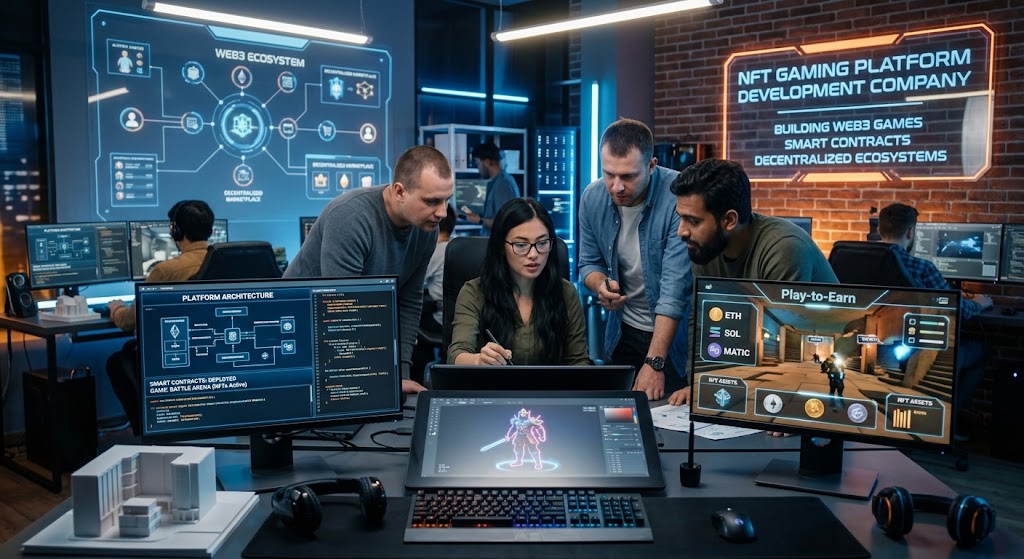
NFT Gaming Platform Development Company: Building Next-Gen Play-to-Earn Ecosystems
Gaming has shifted drastically over the past few years. Players no longer want to spend hundreds of hours unlocking virtual items they will never actually own.
They want real ownership. They want digital assets they can trade, sell, or take into other games.
That is where a specialized NFT gaming platform development company steps in. We build decentralized systems that turn traditional video games into thriving digital economies.
Whether you are launching a collectible card game, a massive multiplayer RPG, or a Metaverse virtual space, Web3 integration changes the rules of engagement. It brings transparency, real value, and long-term player retention.
Building these platforms requires more than just standard game design. It demands secure smart contracts, scalable blockchain architecture, and seamless wallet connections.
Let us explore how modern game studios and Web3 startups turn ambitious ideas into fully functional blockchain gaming platforms.
Why Partnering With an NFT Gaming Platform Development Company Matters
Developing a blockchain game is not just about putting graphics on a screen. It is about building an entire economic engine that runs flawlessly round the clock.
A single mistake in a smart contract can cause massive financial losses. An awkward onboarding process can drive thousands of potential players away before they even finish setting up.
When you work with an experienced NFT gaming platform development company, you avoid these common traps. You get a battle-tested architecture designed specifically for high transaction volumes and smooth player interactions.
Here is what professional Web3 developers bring to your project:
- Custom smart contract creation for minting, staking, and trading in-game items.
- Cross-chain interoperability to let players move assets across Ethereum, Polygon, Solana, and BNB Chain.
- Ultra-secure digital wallet integration supporting popular tools like MetaMask, WalletConnect, and Phantom.
- Decentralized marketplace setups where players buy, sell, and auction unique game NFTs.
- Play-to-earn economic design that balances token inflation and maintains long-term asset value.
Every feature needs to work together without lag or friction. Players care about fun gameplay first. The blockchain backend should work quietly behind the scenes.
Our team ensures that your game feels as smooth as any mainstream AAA title while giving players genuine digital asset ownership.
Core Engineering Architecture of Web3 Gaming Engines
Building a robust gaming environment means tying traditional game loops together with distributed ledger networks. You need fast databases for real-time multiplayer action and immutable blockchains for secure ownership records.
Take a look at how key technical components align across the platform:
| Platform Component | Primary Function | Key Technologies Used |
|---|---|---|
| Game Engine Frontend | Renders real-time visual elements and player interactions | Unreal Engine 5, Unity, Godot, WebGL |
| Smart Contract Layer | Manages token creation, asset minting, and trade execution | Solidity, Rust, Vyper, Hardhat, Foundry |
| Blockchain Networks | Provides immutable ledger tracking and decentralized consensus | Ethereum, Polygon, Arbitrum, Solana, Avalanche |
| Storage Layer | Stores game metadata, high-res 3D assets, and player media | IPFS, Arweave, AWS S3, Filecoin |
| Backend API & Indexing | Syncs live blockchain states with fast game databases | Node.js, Go, GraphQL, The Graph, PostgreSQL |
This hybrid structure ensures that high-speed actions like movement or combat stay instant. At the same time, high-value events like item drops and token payouts stay fully secure on-chain.
Getting this balance right is the difference between a game that scales smoothly and one that crashes under heavy load.
Key Features Delivered by an NFT Gaming Platform Development Company
What actually goes into a world-class Web3 gaming platform? It comes down to features that empower both players and operators.
Players need intuitive controls and clear item values. Operators need powerful administrative management tools and continuous economic monitoring.
Here are the essential features every project needs:
- In-Game NFT Marketplaces with custom filtering, filtering by rarity, and instant settlement.
- Gasless Transaction Layers so players can play without paying network fees for every minor action.
- Fiat On-Ramps allowing credit card purchases directly into native game tokens or NFTs.
- Staking and Yield Portals where players lock up rare items to earn passive rewards.
- Guild Management Dashboards for tracking shared gaming assets, earnings, and asset rentals.
When these features line up, player retention goes up significantly. Players become invested stakeholders who stay active for months or years.
Here is a breakdown of common NFT standard implementations in modern titles:
| Token Standard | Asset Type | Typical In-Game Usage |
|---|---|---|
| ERC-721 / SPL Non-Fungible | Unique Non-Fungible Tokens | One-of-a-kind land plots, legendary weapons, unique characters |
| ERC-1155 / Multi-Token | Semi-Fungible & Batch Assets | Consumable health potions, standard ammo, crafting resources |
| ERC-20 / Fungible Token | Fungible Utility Currency | In-game gold, governance tokens, reward points |
| ERC-6551 / Token-Bound | Backpack / Account NFTs | Inventories attached directly to character avatars |
Choosing the right token standard keeps gas costs low and makes trading far easier for your player base.
The Development Process: From Concept to Mainnet Launch
Creating a successful Web3 title requires a methodical approach. Skipping steps in security or economic testing can ruin a game launch overnight.
So how do we take your vision and build it into a finished product? Here is how it works:
- Economic & Strategy Design: Defining token supply, sink mechanisms, and minting rules.
- Smart Contract Architecture: Writing clean, modular code optimized for minimal gas usage.
- Game Loop Integration: Linking game engines like Unity or Unreal to blockchain SDKs.
- Comprehensive Security Audits: Testing smart contracts against exploits, reentrancy, and flash loans.
- Mainnet Deployment & Staging: Launching infrastructure on testnets before full production release.
This structured workflow keeps your launch on track while protecting your business against critical security vulnerabilities.
Frequently Asked Questions
What Is an NFT Gaming Platform Development Company?
It is a specialized software development provider that builds Web3 video games, smart contracts, decentralized marketplaces, and custom blockchain game engines for gaming studios and startups.
How Long Does It Take to Build an NFT Gaming Platform?
A basic Web3 game prototype can take around 3 to 4 months to complete. Full-scale AAA multiplayer games with custom marketplaces and multi-chain setups usually require 8 to 12 months or longer.
Which Blockchains Are Best for NFT Game Development?
Polygon, Immutable X, Solana, Arbitrum, and BNB Chain are popular choices because they offer low transaction fees and high processing speeds needed for real-time gameplay.
How Much Does Web3 Game Platform Development Cost?
Costs vary depending on game complexity, visual fidelity, and smart contract design. Simple 2D games start around thirty thousand dollars, while complex 3D multiplayer platforms cost significantly more.
Can Traditional Video Games Be Converted Into NFT Games?
Yes. Existing traditional games built on Unity or Unreal Engine can integrate Web3 features through SDKs, custom wallet integrations, and smart contract APIs without rebuilding the core game engine.
How Do NFT Games Earn Money for Developers?
Developers earn revenue through transaction royalty fees on secondary marketplace sales, primary NFT mint sales, token transaction fees, and in-game item purchases.
Are Smart Contract Audits Necessary Before Launching an NFT Game?
Yes. Audits are essential to identify security vulnerabilities, protect player assets, and prevent malicious attacks or exploits before deploying smart contracts onto live blockchain networks.
Building a successful Web3 game demands the right mix of creative design and secure engineering. Choosing an experienced NFT gaming platform development company gives you the technical foundation, economic security, and scalable infrastructure needed to create unforgettable player experiences that thrive in today’s decentralized digital market.


Leave a Reply