
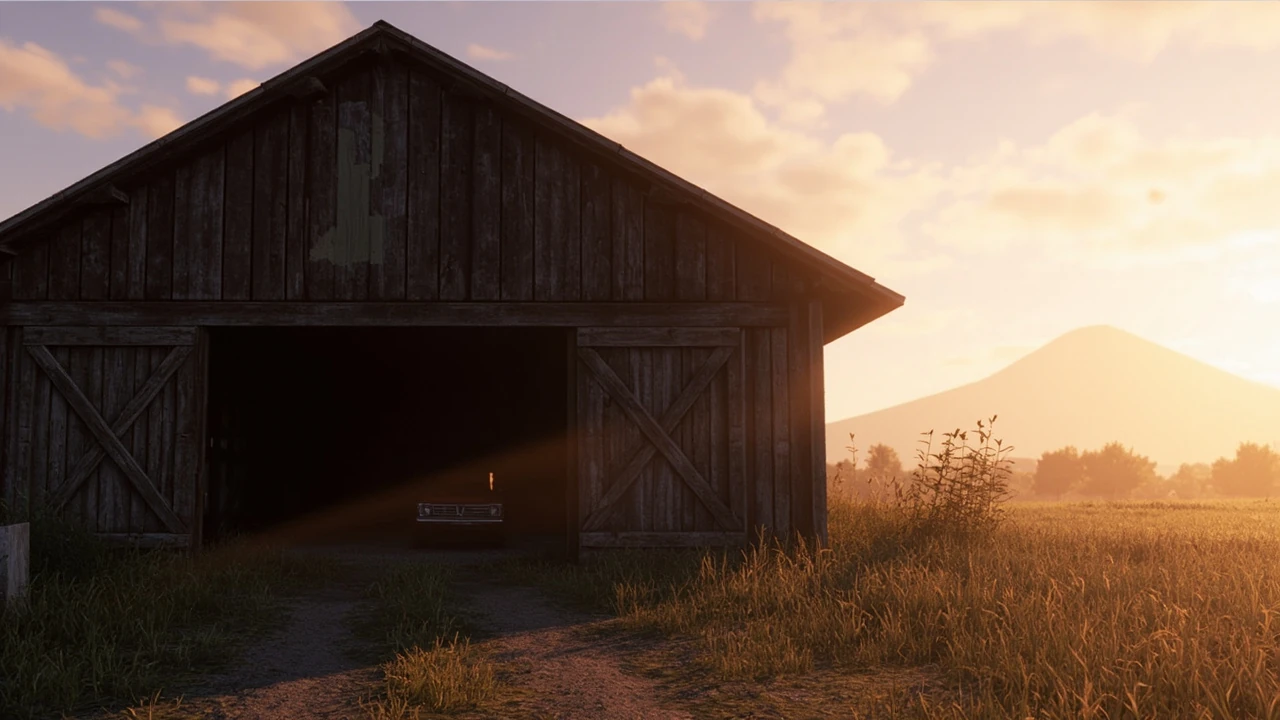
Forza Horizon 6 barn finds: how the mechanic works and what to expect
Forza Horizon 6 barn finds are the next entry in a series tradition that turns exploration into the core reward loop. The rhythm is familiar: drive past an unremarkable shed, hear the audio cue, push through the wooden door, and add a forgotten classic to the garage. The mechanic blends environmental storytelling, light puzzle design, and tuning depth into a single moment, and it has become one of the reasons players keep returning to the Horizon map.
What changes between Horizon entries is rarely the surface idea. The Forza series has treated barn finds as both content and craft, layering in audio cues, map design, and progression gating as the engine and world tools evolve. Understanding the mechanic means understanding how Playground Games and Turn 10 Studios think about open-world pacing, and how a hidden car can carry more narrative weight than a scripted cutscene.
This breakdown covers how the barn find feature has matured across the series, what players can reasonably expect from Forza Horizon 6, and how the design choices behind the mechanic connect to broader game production decisions. It is aimed at players planning a completionist run, designers curious about open-world reward systems, and developers interested in how a single feature can anchor a long session.
What barn finds actually are in the Forza Horizon series
Barn finds are a specific class of hidden collectible built around a discovery loop rather than a checklist. The game scatters small, weathered structures across the open world, each one hiding a car that has been left to decay. The loop runs like this: explore without a marker, recognize the visual or audio signal that something is nearby, push the car out of the barn, repair it, and add it to the garage.
Three design decisions give the mechanic its weight. The first is contrast between activity around the barn and the stillness inside it. Most Horizon events are loud, timed, and competitive; a barn is quiet, solitary, and unprompted. The second is the storytelling implication of the find itself. The car usually has a short history note that frames it as a recovered piece of automotive history, which gives the moment an archaeological tone rather than a shopping one. The third is the restoration path, which lets the player take a wrecked shell and turn it back into a drivable machine.
For developers, the mechanic is a useful study in how a single feature can serve several disciplines at once. It supports world artists by giving them a reason to scatter environmental detail beyond the racing routes. It supports audio designers by requiring distinctive cues that do not break the ambient soundscape. It supports progression designers by offering high-value rewards that are gated by exploration rather than raw speed. It also tests the world’s navigation and minimap design, because a mechanic that depends on curiosity only works when the surrounding environment rewards it.
How barn finds fit into the wider Forza Horizon design language
The Horizon series has always treated its map as the actual product. Cars, tuning, the livery editor, and the festival structure all sit on top of an open world that is meant to be traversed for its own sake. Barn finds are one of the most deliberate uses of that world, because they do not require any racing skill to unlock. A driver who never finishes a single event can still collect every hidden car.
This separation between skill-based and exploration-based progression is a recurring Forza pattern. Skill-based rewards tend to be cosmetic or competitive, such as ranked multiplayer cosmetics, Forza Driver Points, or leaderboard recognition. Exploration-based rewards tend to be permanent collection content, such as barn finds, hidden houses, or story cars. Splitting the two pools keeps the open world feeling generous even for players who never finish a campaign event.
Within that design language, barn finds sit closer to narrative than to skill. The audio cue, the weathered textures, and the repair animation lean into a tone the Forza team often treats as automotive heritage. The mechanic is not simply a way to give away free cars. It is one of the few systems that lets the world itself feel like a curated garage, and that gives it long-term value across the series.
The production pipeline behind a single barn find
Building a barn find is a small but cross-disciplinary task. It begins with a level designer choosing a coordinate in the open world that is off the racing line, but not so far away that the player can never reach it. The coordinate has to fit the lighting, the road network, the streaming setup, and the minimap readability of the surrounding region. A bad location can hide the find forever, which defeats the purpose of the mechanic.
Once the coordinate is locked, the world art team places the barn. That step usually involves a kit-built structure with weather, dirt, and signage that is intentionally inconsistent with the rest of the festival environment, so it reads as forgotten. Texture work matters more than geometry; the paint has to look sun-bleached, the wood has to look warped, and the door has to look half-broken without being read as broken geometry by the engine.
Audio and scripting come next. The barn find audio cue has to be loud enough to be heard over a dynamic soundtrack, but quiet enough that the player can miss it if they are moving too fast. The trigger volume around the barn has to be wide enough to forgive slightly off-line driving and tight enough to avoid false positives. The restore animation is sequenced by the animation team, usually against a generic rig, and the post-restore car spawn has to be consistent across platforms because streaming and memory budgets differ between console generations.
QA plays a role that is easy to underestimate. Each barn find has to be tested with a freshly started save, a save near completion, and a save in which other barns have already been collected, because the cue logic and the trigger volume sometimes change with progression. Testers also verify the restoration works on every supported input device, because the moment is sometimes the first time a player uses a specific button prompt for the entire run.
What the Forza Horizon 6 map changes for barn finds
Forza Horizon 6 expands the series formula by setting the festival in Japan, which changes the visual language of the world and the way barn finds can hide inside it. Previous Horizon maps tended to be wide and visually consistent, with a single dominant biome and a single dominant color palette. Japan offers a much higher density of distinct environments, from dense city blocks to mountain passes, coastal roads, and rural villages, and that density directly affects how a discovery mechanic can be hidden.
For players, the practical effect is that barn finds are likely to be harder to spot at speed in Forza Horizon 6 than in earlier entries, simply because the world offers more visual noise. A wooden shed in a forest is easy to see. A wooden shed pressed against a temple wall or a coastal village is much harder, because the surrounding geometry competes for attention. That is good design pressure, because it forces the audio cue to do more work and rewards players who actually slow down.
For developers, the same density raises the cost of placing every barn by hand. Most modern open-world projects use a mix of hand-placed hero content and procedurally distributed filler. Barn finds almost always sit in the hand-placed category, because each one has to be tuned to its surroundings, but a denser world means more candidates and a longer curation pass. The Horizon team’s tooling usually reflects this: curators can flag, score, and dismiss candidate placements in-engine before a final list is locked.
Another change players can reasonably expect is a wider variety of barn structures. Past Horizons reused a small set of barn models per biome, which is the right call for memory and asset budgets but can make repeat finds feel identical. A Japan setting opens the door to a larger kit of rural architecture, which helps both immersion and the moment of surprise when a player walks up to a barn that looks slightly different from the last one.
What is already known about barn finds in Forza Horizon 6
Forza Horizon 6 was officially revealed at the Xbox Games Showcase in 2025, and Playground Games has confirmed the Japan setting. Beyond the setting and the broader feature pillars, the studio has kept specific barn find details under wraps until closer to launch. That is consistent with the series’ history, because barn finds are treated as discovery content, and revealing locations in advance can undercut the loop that gives them value.
Players searching for a confirmed list of Forza Horizon 6 barn finds today will mostly find wishlists, speculation, and pre-release guides based on leaked map data. Those are useful for hype, but they are not the same as verified game content. The reliable place to look once the game ships is an updated, sourced guide such as the Game8 Forza Horizon 6 barn finds locations and map page, which updates after release with confirmed coordinates and rewards. For a player planning a release-day run, that is the right bookmark to set, not a pre-launch rumor thread.
What is safe to expect based on series history is the rough shape of the feature. The game will probably include a small set of barn finds tied to the campaign, several hidden in the open world, and a handful tied to specific events or DLC updates. The exact count and the gating rules tend to vary between entries, so any number cited before launch should be treated as placeholder.
How barn finds compare across the Horizon series
The mechanic has evolved in clear stages since the first Forza Horizon. Looking at the design trajectory helps explain why Forza Horizon 6 is likely to push the feature further rather than simply repeat it.
| Title | Map focus | Barn find design notes | What changed |
|---|---|---|---|
| Forza Horizon (2012) | Colorado, USA | Introduced the mechanic with a small set of hidden barns and dedicated audio cues. | Established the explore-to-find pattern and the basic restoration flow. |
| Forza Horizon 2 (2014) | Southern Europe | Tied barns to specific regions, with a higher density along rural roads. | Added regional gating and stronger integration with road exploration. |
| Forza Horizon 3 (2016) | Australia | Expanded the count, with barns tied to the campaign and the open world separately. | Separated story-driven and exploration-driven finds. |
| Forza Horizon 4 (2018) | United Kingdom | Introduced seasonal barn finds, where some barns only appeared in specific seasons. | Added a time-gated layer that raised the planning cost of a completionist run. |
| Forza Horizon 5 (2021) | Mexico | Refined audio cues and visual contrast, and added more variation in barn structures. | Improved the discoverability balance so the loop felt more forgiving. |
| Forza Horizon 6 (2026) | Japan | Expected to leverage a denser, more varied open world and stronger audio cues. | Likely to push harder on hiding the finds against dense environment geometry. |
The table is a design history inferred from publicly shipped entries, and it shows a clear pattern. Each generation refines the loop without abandoning it, and the refinements usually track the strengths and weaknesses of the new map. Japan, with its dense environment, is exactly the kind of setting that pushes the audio cue to do more work, because the player cannot rely on sight alone to find a barn.
| Series era | Core design priority | Weakness that shaped the next entry |
|---|---|---|
| Horizon 1 to 2 | Introduce the discovery loop | Finds felt too clustered, which reduced surprise. |
| Horizon 2 to 3 | Tie barns to campaign and exploration separately | Restoration was treated as pure UI, with limited narrative framing. |
| Horizon 3 to 4 | Add time gating through seasons | Seasonal gating frustrated completionists who had to wait out real-world weeks. |
| Horizon 4 to 5 | Rebalance discoverability and audio cues | The map was so wide that some finds felt disconnected from the racing line. |
| Horizon 5 to 6 | Leverage dense, varied Japanese geography | Visual noise in tight regions can hide barns, which raises the cost of pure sight-based hunting. |
That second table is a useful way to read the pattern: every entry’s weakness becomes a design brief for the next one, and the Forza Horizon 6 development team has to balance the density of a Japanese map against the forgiving discovery feel of the Mexico entry.
Why barn finds still matter as a design pattern
Barn finds survive in a series that reinvents its feature list every few years because they do three things well that are genuinely hard to replicate. They reward curiosity without punishing skill. They give the open world a quieter counterpoint to the loud festival events. They create a small narrative for every car, which the rest of the game cannot do at the same scale.
For designers, the loop is a useful template because it works across genres. A survival game can hide a cache behind a similar discover-to-reveal pattern. An RPG can hide a rare weapon in an unmarked ruin. A strategy game can offer a one-time reveal that depends on a player choosing to inspect a corner of the map. The specific content of a barn find is less important than the shape of the experience around it.
For producers, the mechanic is also a useful scheduling anchor. Barn finds are small enough to scope, large enough to motivate a feature team, and late enough in production that they can be tuned against final map layout. The count and the gating rules often shift during development for that reason, and the mechanic is forgiving to iterate on, which is rare in open-world content.
Designing the audio cue that makes a barn find land
The audio cue is the most underrated part of a barn find. Visual contrast can fail in bad lighting, the minimap can be cluttered, and the player can simply be moving too fast. A good cue survives all three failure modes. The Horizon series has used a combination of ambient change, a short musical sting, and a controller rumble to signal proximity, and the balance between those layers is what gives the mechanic its feel.
The technical challenge is that the cue has to be louder than the dynamic soundtrack without feeling artificial. In practice, the audio team ducks the music, raises the ambience, and triggers a subtle musical motif that the player learns to associate with discovery. The same system is reused for other hidden content, so the player gradually learns a shared audio vocabulary across the game. That is a much better outcome than a single, unique sound for every hidden feature, because it teaches the player how to listen to the world.
For smaller teams trying to borrow the pattern, the lesson is to invest in the cue. A bad cue will silently break a discovery mechanic, and most players will blame themselves rather than the audio. A good cue turns the find into a teachable moment that carries the player into the rest of the open world.
How the restore loop shapes player attachment
The restore loop is the second half of the barn find experience, and it decides whether the find feels like a reward or a chore. In the modern Horizon games, the player pushes the car out of the barn, watches a short scripted beat, and then has the option to either drive the wreck to a restoration shop or fast-track the repair through the menu. Both paths are valid, and the choice is a small but real expression of player preference.
The restoration itself is handled as a separate UI flow rather than a minigame, which is a deliberate design decision. The Horizon team has consistently chosen narrative beats over mechanical depth for barn restoration, because the find has already done the heavy lifting. Adding a tuning minigame on top would extend a moment that benefits from staying short. That is a useful counter-example for designers who assume every reward should come with a complex payoff.
What the loop does well is hand the player a car that is mechanically interesting rather than merely rare. The series tends to put historically significant or fan-favorite machines inside barns, which means the restoration often pays off in tuning depth as well as in collection progress. The car is not just a checkmark. It is something the player can take into a Horizon Open event that night.
Practical tips for a release-day barn find run in Forza Horizon 6
Players who want to plan ahead should treat the launch window as a discovery period rather than a checklist. The following approach has worked across previous Horizon releases and is likely to hold up in this one.
- Drive the perimeter of each map region before chasing any specific marker. Barn finds are biased toward the edges of the world, and a slow first pass surfaces most of them naturally.
- Use headphones or a surround setup if possible. The audio cue is doing more work than the visual contrast in a dense map, and that matters more in a Japan setting than in a desert.
- Avoid guides until after the first day of play. Walking into a barn find cold is part of the value, and a spoiler costs the player a moment the developer spent weeks tuning.
- If a guide is needed, use one that updates after launch, such as a current barn finds map, rather than a pre-release rumor list.
- Save before any long exploration session. The series occasionally gates a barn behind a story event, and a clean save prevents the need to replay a chapter.
None of this requires min-maxing. The mechanic is designed to be forgiving, and the worst outcome of a slow approach is a slightly longer completion percentage, not a missed feature.
What a developer can learn from a single feature
Barn finds are useful as a case study because they are small, observable, and shipped. They show how a single feature can carry world art, audio, progression, narrative, and QA at once, and they survive in a series that has every reason to retire them. For studios building a new open world, the pattern is worth copying in spirit, even when the content is completely different.
The minimum ingredients are a discovery signal that is both visual and audio, a small but well-tuned reward, a short scripted beat that frames the find, and a map that rewards curiosity without punishing it. None of those ingredients require a large team. They do require discipline, because the temptation is always to layer more mechanics on top of a feature that works precisely because it stays simple.
The Horizon series has resisted that temptation for six entries. Forza Horizon 6 is unlikely to be the one that breaks the streak.
Where the barn find loop ends and the rest of the game begins
Once the cars are collected, the mechanic fades into the background, and the rest of the Forza Horizon 6 feature set takes over. The barns were never meant to be the main event. They are the pause between events, the quiet beat that makes the louder content feel louder. Treating them as a checklist is the fastest way to miss what the developers actually built.
The best way to play is the same way the developers hoped the game would be played. Drive past the festival markers when the map looks interesting. Stop when the audio changes. Push the door open even if the building does not look important. The barns are the most patient feature in the game, and they reward exactly the kind of player who treats an open world as something to wander through rather than something to clear.
For players who want a more concrete reference once the game ships, a post-launch source like the Game8 Forza Horizon 6 barn finds locations and map page is the kind of updated guide worth bookmarking on day one, since it tracks confirmed finds and rewards rather than pre-release rumors.
Frequently asked questions
How many Forza Horizon 6 barn finds are there?
The exact count has not been confirmed publicly before launch. Based on the series history, the game will likely include a small set of barn finds tied to the campaign, several hidden in the open world, and a handful tied to specific events or post-launch updates. Any pre-release number should be treated as a placeholder until the studio confirms it after launch.
Do barn finds require DLC or special editions in Forza Horizon 6?
Past entries have always included the base-game barn finds for every player, with the restored cars delivered as standard garage content. Some editions or DLC packs have historically added bonus cars through separate rewards, but the discovery mechanic itself is not locked behind a paid tier. Players should expect the same approach in Forza Horizon 6 unless Playground Games confirms otherwise.
Can barn finds be missed permanently in Forza Horizon 6?
The series has consistently avoided permanent missables for the base barn find set, because that would conflict with the explorer’s reward structure. The more common pattern is a small time gate, such as a campaign chapter or a specific event, after which the find becomes available. Seasonal gates similar to Forza Horizon 4’s winter-only barns are also possible but not confirmed for this entry.
Are Forza Horizon 6 barn finds replayable after restoration?
Once a barn find is restored, the building typically remains in the world as an empty shell, and the car is added to the player’s garage. Players cannot re-trigger the discovery moment, but the car is fully drivable and tunable in every mode that allows it, including online sessions unless the playlist rules restrict the specific car.
Will the Forza Horizon 6 barn finds map work on every platform?
The mechanic itself is the same on every supported platform, and a barn find map guide will be valid for all of them because the world is identical. The only platform-specific difference is performance, which can change how easy it is to hear the audio cue at high speed. Headphones help on every platform.
How do barn finds compare to Forza Horizon 5’s mechanic?
The base loop is the same: explore, find, restore, drive. The differences are likely to be visual contrast, audio balance, and the structure of the open world. Forza Horizon 5 had a very wide, visually consistent map, which made the cue forgiving. Forza Horizon 6’s denser Japan setting is likely to push the cue to do more work, so players should expect a slightly harder discovery experience overall.
Do I need a specific car class or tuning setup to find a barn?
No. Barn finds are not gated by car class, performance index, or tuning setup. Any drivable car in the player’s garage can trigger a find, because the trigger is based on player position and progression, not on vehicle stats. A starter car works as well as a fully tuned supercar.
Are there any spoilers I should avoid before launch?
Yes. Map coordinates, screenshot leaks, and datamined lists all count as spoilers, because the discovery moment is part of the reward. The safest approach is to avoid pre-release barn find guides and play the first session without a map, then check a current source like an updated barn finds locations page if a specific find is genuinely hard to locate.
Will post-launch updates add more barn finds?
Previous Horizon games have added new cars through expansions, Forzathon events, and seasonal playlists, but those have usually been delivered through event rewards rather than new barn finds. A new barn is more likely to appear in a major expansion than in a weekly event, and the studio usually announces that kind of addition in advance.
What is the best way to find every barn in Forza Horizon 6?
The most reliable approach is a slow first pass through each map region without a guide, followed by a current post-launch map for any specific finds that turn out to be hard to spot. The combination respects the discovery moment and still keeps the completionist run on schedule. Patience usually matters more than route optimization.




Leave a Reply