
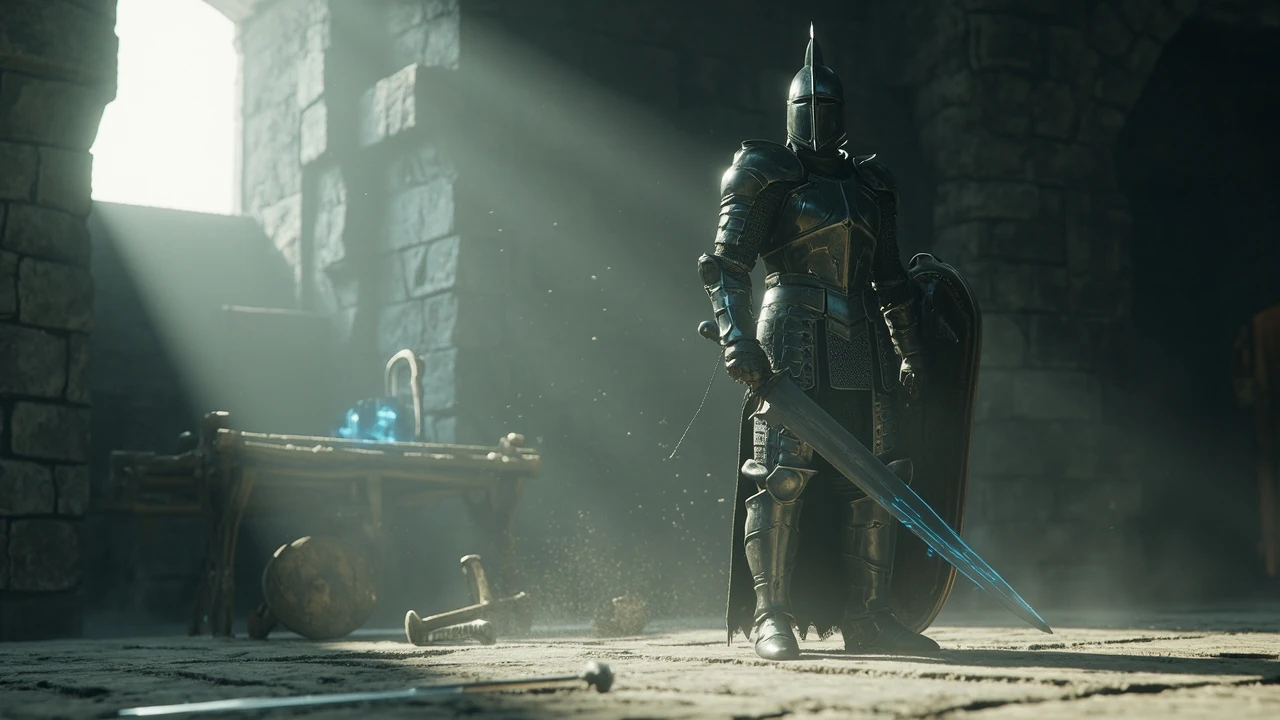
Sword and shield starter evolutions
A starter evolution line is one of the first systems a player experiences, and it carries a heavy load: it teaches the core combat loop, signals the game’s identity, and produces a creature or character that the audience will follow for tens or hundreds of hours. The sword and shield archetype, in particular, has to teach protection as a verb, not just as a stat. The evolution pattern matters because the same starting silhouette usually has to branch into two or three adult forms, and each branch needs distinct silhouette, motion, audio, and balance, all while reading as the same lineage.
This article is written for the people who actually have to ship that system: gameplay engineers, combat designers, technical artists, animators, and producers who own the starter pipeline. It covers the design decisions that shape sword and shield starter evolutions, the data and runtime patterns used to implement them, the art and animation costs, and the most common production traps. The goal is a single reference that lets a team evaluate an existing design, plan a new one, or audit a build that is not reading the way it should.
Why the sword and shield starter is a design problem, not just a creature slot
The sword and shield combo is a deliberate teaching tool. Early combat has to communicate three things at once: attacking has a cost (stamina, animation commitment, or positioning), defending is a real verb the player chooses, and trading damage for safety is a meaningful decision. When the starter evolves, those verbs have to remain legible while scaling. A line that turns into a heavy armored knight teaches tempo and commitment. A line that turns into a quick fencer teaches spacing and feints. A line that turns into a guardian tank teaches positioning and threat management. The evolution is not a new creature; it is a new combat identity built on the same starting chassis.
This is the first place sword and shield starter evolutions differ from a more generic three-stage monster line. The weapon pair is the visual and mechanical anchor. Even when the final form has a single massive blade or a tower shield, the player should still feel the lineage back to that first paired loadout. Designers who treat the evolution as only a stat curve usually end up with three creatures that look related but play like three separate prototypes. Treating the evolution as a combat identity migration gives the line a single internal logic that art, animation, and balance can all support.
Common evolution structures used in shipped games
Most successful sword and shield starter evolutions fall into one of three structural patterns. The choice between them is usually driven by genre, progression length, and the number of distinct final forms the team can afford to build.
| Pattern | Typical branch count | Core teaching | Production cost | Risk if rushed |
|---|---|---|---|---|
| Linear upgrade path | One final form, with optional mid-stage variants | Mastery of the starting kit | Lowest; shared rig and animations scale cleanly | Final form feels like a reskin rather than a payoff |
| Tri-stage branch | Two or three distinct final forms, chosen mid-game | Identity choice with permanent role | High; each branch needs unique animation set, VFX, and balance | Branches feel unbalanced; one path dominates |
| Modular loadout evolution | Shared base, weapons and stance selected as a build | Systemic mastery rather than single identity | Highest design cost, lower art cost per branch | Identity drift; no single form feels iconic |
The linear path is the safest for small teams and short campaigns. The tri-stage branch is the most common in long-running monster-taming and RPG lines because it gives the player a real choice. The modular pattern is rarer in starter evolutions because starters need a clear identity, but it shows up in games where builds are the progression.
Designing the branch: what each evolution must commit to
Before any art or code work begins, a branch needs a written commitment sheet. The team’s job is to make the three evolution targets feel like they could only exist as descendants of the starter, while still being distinct enough to justify the choice. A useful commitment sheet covers six areas:
- Combat role: tank, bruiser, duelist, or hybrid. This drives stance, frame data, and stamina rules.
- Weapon silhouette: how the sword and shield pair has changed. Longer blade and smaller shield, heavier blade and tower shield, paired swords with buckler, or sword and board with ranged element.
- Mobility profile: does the evolved form trade speed for safety, or the reverse?
- Signature mechanic: one verb the branch owns. Examples include parry into riposte, shield charge, deflection timing, or stance swap.
- Audio identity: shared theme with a branch-specific layer. The shield strike and sword swing should keep a recognizable timbre while the evolved form layers in low brass, choir, or percussive accents.
- Story hook: why this branch is canonically reachable. Players notice when a branch feels like a what-if rather than a designed outcome.
A team that skips this sheet usually ends up with a branch that looks great in a key art render but fights like a recolor of the starter because the combat role was never decided.
Data architecture for evolutions
Once the design commitments are written, the data layer is what keeps them honest at runtime. There are three patterns that cover most shipped implementations. Each has trade-offs that matter when the team has to support multiple branches and patch them independently.
| Data pattern | How evolutions are stored | Strengths | |
|---|---|---|---|
| Flat stat table per stage | Each stage is a row of numeric fields | Simple to author, easy to balance | Hard to share logic between branches; copy-paste drift is common |
| Inheritance graph | Stages inherit fields from a parent stage, overriding only what changes | Single source of truth for shared traits, cleaner patches | Tooling must visualize the graph; designers need a debug view |
| Component composition | Each stage is a list of behavior and stat components | Maximum reuse, easy to add new branches late in production | Balance is harder to reason about; tooling cost is highest |
For sword and shield starter evolutions specifically, the inheritance graph is usually the sweet spot. The starter defines shared base values, combat rules, and core animations. Each mid stage overrides the silhouette, the shield size, and one or two combat verbs. Each final form overrides the signature mechanic, the audio theme, and the role-specific frame data. Designers can tune a single field in the base and watch it propagate, which is exactly the workflow a balance team needs during a public test.
Runtime implementation: the state machine and the evolution event
The interesting engineering work is not the data table; it is the moment the evolution fires. Most teams model the starter as a state machine with combat states (idle, windup, swing, recovery, block, parry) and meta states (overworld, cutscene, evolution). The evolution event has to do four things in a defined order:
- Lock input and queue any in-flight combat resolution. The player should not lose damage to the evolution animation.
- Swap the visual rig to the target stage, including weapon meshes, shield, armor, and any attached VFX sockets.
- Reconcile the active ability set, including cooldowns, buffs, and any resource meters. Some games reset cooldowns on evolution as a power fantasy; others preserve them to keep the moment tense.
- Trigger the evolution VFX, camera beat, and audio sting, then release input to the new form.
Each of those steps has a failure mode. The most common is step three: the ability set is reloaded from data, but any active buff or debuff was tracked on the old form’s component and is lost on swap. The fix is to keep status effects on a stable owner object that survives the rig swap, and to serialize the effect state into the new component on instantiation. This is the kind of bug that QA catches only in long sessions, which is why the implementation needs a reproducible test case for every branch.
Animation and rig planning for evolutions
Animation is where sword and shield starter evolutions usually exceed budget. The naive plan is to build a new rig for each stage. The realistic plan is to build a shared skeleton with modular attachments and a small set of branch-specific clips. The shared skeleton covers locomotion, basic attacks, and the block and parry verbs. The branch-specific clips cover the signature mechanic, the evolution transition, and any stance changes.
Three production rules help keep this manageable:
- Lock the proportion space early. A starter that is 1.0 scale, a mid stage at 1.15, and a final form at 1.3 will not share many of the heavier armor meshes. A starter at 1.0, mid at 1.05, and final at 1.1 will share far more and animate more consistently.
- Keep the weapon socket separate from the hand. The sword and shield both attach to named sockets, so the rig can swap the weapon pair without rebuilding the hand.
- Reuse the same mocap source for the sword swings, even when the final form holds a different weapon. Players read swing arcs faster than they read blade shape, so consistency in motion is more important than consistency in weapon.
The evolution transition animation deserves its own treatment. It is a hero moment and it is the first impression of the new form. Teams that try to blend from the starter idle to the final form usually get a slow, awkward cut. Teams that author a dedicated transition clip with a clear pose, a strong silhouette change, and a single camera beat get a moment that the player will remember and share.
Art direction: silhouette, palette, and the shield as a canvas
The shield is the most useful surface in the entire evolution line. It is a flat plane that the player sees from above, in front, and in profile, and it survives every combat state. Three uses of the shield carry most of the visual identity work:
- Silhouette: a round shield reads as quick and defensive, a kite shield as a knight, a tower shield as a wall, and a buckler as a fencer. The shape change between starter and final form is the single fastest signal of branch identity.
- Heraldry: a crest, a rune, or a faction mark. The starter wears a plain or generic mark; the final form wears a branch-specific mark. This is cheap to author and instantly readable.
- Damage states: scratches, dents, and burn marks. A shield that takes visual damage over a long run tells a story without a single line of dialogue.
Palette is the other lever. A consistent palette across all branches keeps the line readable as one lineage. A branch-specific accent (cold blue for the guardian, warm red for the duelist, pale green for the hybrid) gives the choice its own identity. Teams that try to change the base palette between branches usually end up with a starter that no longer looks related to its evolutions.
Balance: reading the line at scale, not in isolation
For additional context, Balance for sword and shield starter evolutions has to answer a specific question: at the level where the player commits to a branch, does each branch feel like a fair trade for the others? This is harder than it sounds because the player is choosing on incomplete information, and the answer only emerges after dozens of hours.
The balance work splits into three passes. The first pass is the design pass, which uses the commitment sheet to confirm each branch has a real role and a signature mechanic the others do not have. The second pass is the data pass, which models expected DPS, survivability, and utility at the branch-commit level and at the level cap. The third pass is the live pass, which reads telemetry from the public test or soft launch and looks for divergence. A branch that is picked by 80 percent of players is not necessarily overpowered; it is a signal that the other branches are not reading as clearly. A branch that is never picked is a signal that the commitment sheet was not communicated to the player.
There is a useful diagnostic for the third pass. If the choice happens at level 15 in a 60-hour game, and 70 percent of players are in branch A, 20 percent in branch B, and 10 percent in branch C, the question is not which branch is strongest. The question is which branch the player believed they were choosing when they read the in-game presentation. Designers who can answer that question from the commitment sheet, without looking at the data, are usually the ones whose branches balance themselves.
Audio design for evolutions
Audio is the cheapest way to make a sword and shield starter feel like it has grown up. The shared layer is the strike profile: the timbre of the sword on impact, the resonance of the shield when it blocks, and the footfall weight of the armor. The branch layer is a small set of motifs: a low brass phrase for the guardian, a high string phrase for the duelist, and a percussive phrase for the hybrid. The transition itself uses a single sting built from the shared layer plus a branch-specific tail.
Two rules help. First, the evolution sting should not introduce a new instrument family. The branch layer adds a register, not a new palette. Second, the shield impact sound is the most repeated sound in the entire line, so it deserves the most iteration. A starter that thuds and a final form that rings is a satisfying arc. A starter that rings and a final form that thuds is confusing.
UI, inventory, and how the player sees the evolution
The UI work for evolutions is small in volume and large in trust. The player needs three screens: a pre-evolution preview, a transition moment, and a post-evolution summary. The preview is a still or short loop of the final form with the branch-specific weapon and shield. The transition moment is the in-engine camera beat. The post-evolution summary is a stat card that shows what changed, what was added, and what was removed.
Two UI rules matter. The stat card must show the delta, not the absolute values, because the player chose the branch for the change, not the totals. And the preview must use the same camera and lighting as the in-engine transition, because the player will judge the new form by the preview first, and the in-engine reveal will be a disappointment if the silhouette does not match.
Production: ownership, milestones, and review gates
Evolutions cross every discipline, which is why they slip schedules. A starter that needs three branches will have roughly three times the work of a single-form creature, but the same review slots. The way to keep the schedule honest is to assign a single owner who is accountable for the read across all three branches, and to gate milestones on the read, not on the per-discipline checklist.
Useful milestones for a sword and shield starter evolution line:
- Design lock: commitment sheet approved for all branches, including signature mechanics and balance budget.
- Vertical slice: one branch playable from starter to final form, with placeholder art and final combat rules.
- Animation lock: locomotion and core combat clips signed off for the shared rig, with branch-specific clips in progress.
- Art lock: silhouette, palette, and shield heraldry signed off for all branches.
- Balance lock: each branch at parity in design pass, data pass, and first telemetry pass.
- Ship: the line is a system, not a series of creatures, and the patches can tune one branch without breaking the others.
Each milestone answers a question the previous one did not. The vertical slice answers whether the design reads in motion. The animation lock answers whether the branches feel like the same creature grown up. The balance lock answers whether the choice is fair.
Common failure modes and how to avoid them
Most failed evolution lines fail in the same ways. The list below names the patterns and the fix that ships.
- Identity drift: the final form no longer reads as the starter. Fix by locking the silhouette palette and one signature pose that all branches share.
- One-branch dominance: one branch is picked by almost everyone. Fix by reading the in-game presentation, not by nerfing the strong branch in isolation.
- Evolution animation whiplash: the transition is too long or too short. Fix by authoring a single hero clip and timing it against the in-engine camera beat, not against the mocap length.
- Status effect loss on evolution: buffs and debuffs vanish when the rig swaps. Fix by anchoring effects to a stable owner object and serializing state across the swap.
- Audio re-skin: the final form has new music but the same strike profile. Fix by iterating on the shared layer first, then layering the branch motif on top.
- Preview mismatch: the UI preview shows a different form than the in-engine reveal. Fix by reusing the same camera, lighting, and rig in both.
Testing evolutions: what QA actually needs to verify
QA for evolutions is not the same as QA for a single creature. Each branch needs a long-session test that covers the branch from the evolution moment to at least one major story beat, with full ability rotations, status effect interactions, and at least one PvP or co-op encounter if the game supports it. The test must also cover the save and load boundary: if the player saves at the evolution moment and reloads, the new form must appear, the old form must not, and any in-flight effect must be reconciled.
Three checks are worth writing into the test plan explicitly:
- Evolution while a buff or debuff is active on the starter, with the buff persisting and re-resolving on the new form.
- Evolution during a multi-hit ability, with the in-flight hits completing on the old form and the remaining hits on the new form without damage loss or duplication.
- Evolution under network latency, with the server as the authority for the evolution event and the client correcting on the next snapshot.
These are the cases that the implementation needs to handle, and the test plan needs to prove they are handled.
Live operations: patching an evolution line after launch
Once the line is live, balance patches will change one branch without touching the others. The data architecture has to support that, and the change log has to explain it. Players notice when a branch is nerfed without explanation, and they notice even faster when the patch fixes a bug that one branch had and another did not.
A useful live ops rule is to keep the shared base data immutable during a balance patch. Tune the branch overrides, not the base. If the base is changed, every branch changes with it, and the patch becomes a re-balance of the whole line rather than a fix to one branch. This is the kind of change that needs a public test build, not a hotfix.
Decision checklist for a new sword and shield starter evolution
Before a team starts production on a new line, the answers below should be in writing. If any of them are not, the line will slip or read as inconsistent.
- What is the player’s first impression of the starter, and what verb does it teach?
- How many branches exist, and what is the signature mechanic of each?
- What is shared across branches, and what is unique to each?
- What is the silhouette, palette, and shield heraldry of each branch?
- What is the audio identity of each branch, and what is the shared layer?
- What is the data architecture, and how does the team patch a single branch without touching the others?
- What is the evolution animation, and who owns it?
- What is the balance budget for each branch, and what telemetry will the team read?
- What is the milestone gate for each discipline, and who signs off on the read?
A team that can answer these in a single sitting has a design. A team that cannot has a creature and three reskins.
How this fits a game development pipeline
Sword and shield starter evolutions are a useful system to study because they sit at the intersection of design, engineering, art, animation, audio, and production. They expose the cost of decisions that look small on paper and the leverage of decisions that look small in the build. A team that can ship a three-branch evolution line with a shared base, a clear signature mechanic per branch, and a balance loop that survives public testing has built a template that scales to other systems in the game: companion classes, vehicle variants, weapon families, even enemy factions.
For studios looking to extend or audit an existing system, the same checklist applies. The shared base is the inheritance graph node. The signature mechanic is the override. The balance budget is the live ops tool. The milestone gates are the production contract. The pipeline does not have to be new; it has to be coherent.
For teams that need an external partner to take a starter line from design lock to ship, working with a game outsourcing studio that can staff gameplay engineers, technical artists, and animators under a single producer is often the fastest way to keep the read consistent across branches. If the line is part of a larger production, the same engagement can cover companion art, cinematics, and the audio sting.
Frequently asked questions
How many branches should a sword and shield starter evolution have?
Two is the minimum that makes the choice feel real, and three is the maximum that most teams can ship without identity drift. A fourth branch usually means one branch is thin, and the player notices. The branch count is a function of production capacity and the number of distinct combat roles the design needs, not a creative target on its own.
What is the cheapest way to make a starter evolution feel like a new form?
Change the shield shape and the audio theme, keep the rig. The shield is the single most visible surface in combat, and the audio is the most repeated signal. If those two change, the player feels a new form even when the silhouette is close to the starter.
How do we keep balance across branches after launch?
Use the inheritance graph pattern and patch the branch overrides, not the shared base. Read telemetry on branch pick rate, average time to evolve, and win rate in the mode that matters for the game. A branch that dominates in pick rate is usually a presentation problem, not a balance problem.
What is the most common bug in evolution implementations?
Status effects vanishing on the rig swap. The fix is to anchor effects to a stable owner object and serialize state across the swap. This is the bug that QA catches in long sessions and that telemetry does not catch at all.
How long should the evolution animation be?
Long enough to read the silhouette change and hear the audio sting, short enough that the player is not punished for evolving in combat. Most shipped evolutions land between three and six seconds, with the camera doing more work than the character.
Can a starter evolve more than once?
It can, but the cost grows fast. Each additional stage needs a new silhouette, a new audio layer, and a new balance budget, and the player has to remember a new identity. Most shipped lines cap at one or two evolution events per starter to keep the read clear.
What is the difference between an evolution and a transformation in this context?
An evolution is a permanent, data-driven change to the creature’s stage, with a new rig, abilities, and balance. A transformation is a temporary, ability-driven swap, usually with a cooldown. The starter evolution should be the largest single change the player sees in the early game, and every temporary transformation is graded against that benchmark.
How do we test an evolution line under time pressure?
Lock the shared base first, then test the branches one at a time against the base. Each branch test should cover the evolution moment, one long-session run, and the save and load boundary. The branches are independent once the base is locked, which is the point of the inheritance pattern.
What telemetry tells us that an evolution is working?
Branch pick rate close to the design target, average time to evolve close to the design window, and positive sentiment in player feedback on the evolution moment. A spike in negative feedback on a specific branch is almost always a presentation problem, not a balance problem, and the fix is in the in-game description, not the numbers.
When should a studio consider outsourcing an evolution line?
When the line is one of several systems in a larger production and the in-house team is already at capacity. A Unity game development partner with experience in combat systems and data-driven progression can take a line from design lock to ship under a single producer, which keeps the read consistent across branches and disciplines.



Leave a Reply