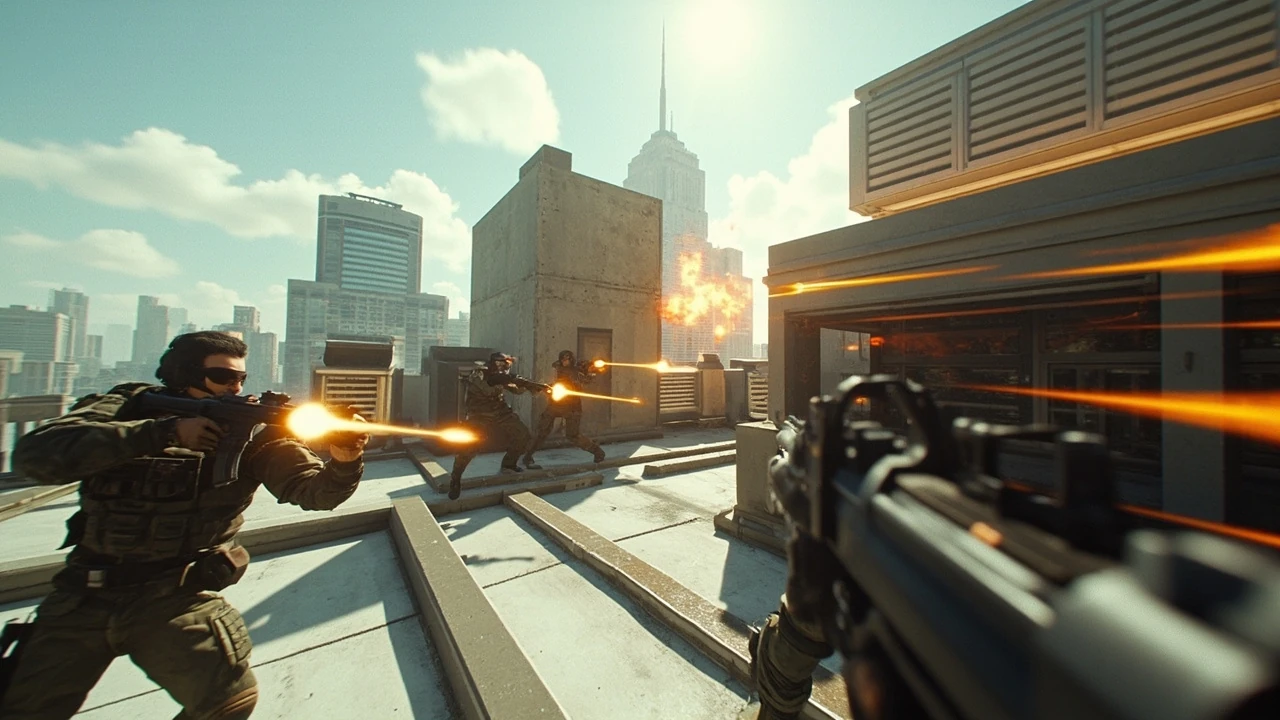
Rogue Company at a glance: a tactical hero shooter built around rounds and Rogues
Rogue Company is a free-to-play multiplayer tactical third-person hero shooter developed by First Watch Games and published by Hi-Rez Studios. The game released in open beta on October 1, 2020, came out of beta on June 9, 2022, and according to its public Wikipedia page is currently in an “as is” state, with its last major update, 3.5, dated November 20, 2023, delivered shortly after development was moved under EvilMojo Games. That timing matters for anyone reading the title as a “live” game today: the product still exists, still runs, and still has players, but the cadence of meaningful content has slowed dramatically.
From a design and production standpoint, Rogue Company is a useful case study because it sits at the intersection of three live-service traditions. It borrows the round-based economy of Counter-Strike, the rotating character rosters of hero shooters, and the cosmetic-driven free-to-play model popularized by Fortnite. It is also a useful case study in how a mid-tier live-service shooter can survive on cross-platform reach for years without a steady update pipeline, and what that survival actually costs the player.
This article walks through the game from a GameDev angle: how the matches are built, how the modes differ, how the development and live operations history shaped the product, and what a player, technical learner, or studio observer should reasonably expect from the title in its current state.
How Rogue Company matches are structured
Every match in Rogue Company is built from the same skeleton: two teams skydive from aircraft onto a map, fight over an objective through one or more rounds, and then spend earned cash between rounds on weapons, perks, and equipment. That structure is the single most important mechanic in the game, because it determines every design decision layered on top.
Rounds are short, typically a few minutes, and the in-match economy mirrors tactical shooters: completing objectives, eliminating enemies, and surviving all generate money. The “buy phase” between rounds is where the tactical depth shows up. A team that lost a round but saved its money can re-equip and pressure the next objective with better tools, while a team that won but spent aggressively on the previous round can find itself outgunned in the next.
The two teams are made up of Rogues, the playable characters, and each Rogue brings a passive or active ability that changes how a round plays. For example, Anvil can place a deployable barricade to block sight lines, Lancer has an ability that silences her footsteps to mask rotations, Gl1tch can detect nearby enemy equipment, Chaac carries a personal Stim Pack, and Trench lays down barbed wire traps that slow enemies and disable their dodges. The 26 Rogues in the roster give the game a wide ability surface, but the core loop still rewards positioning, crosshair placement, and economy management rather than ability mastery alone.
Core game modes and how they diverge
Rogue Company ships with a small set of objective-based modes. Each mode is a variation on the round structure rather than a completely different game, which is a deliberate design choice to keep the buy-phase economy relevant across the entire playlist.
Extraction
Extraction is the headline 4v4 mode. The attacking team is tasked with hacking an objective; the defending team tries to stop them. A round is won when the objective is fully hacked or when one team is fully eliminated. This is the cleanest expression of the game’s economy: each death costs the team more than just a player, because the dead player is also down for the rest of the round and arrives in the next round with less money to spend.
Strikeout
Strikeout is a respawn variation on Extraction. Players return to the fight after a short delay, and each team has a limited pool of respawns per round. Victory can come either by hacking the objective or by depleting the enemy team’s respawn count. Because players come back, the mode reads more like a traditional hero shooter round, but the buy phase at the end of each round still controls the swing between engagements.
Demolition
Demolition is the closest the game gets to a Counter-Strike-style mode. It is a 4v4 round in which one team must plant a bomb within a time limit, and the other team must stop the plant or defuse the bomb. The mode leans harder on utility usage and post-plant positioning than the other modes do.
Wingman
Wingman is a 2v2 variant. Mechanically it is a Strikeout round with fewer respawns and smaller teams. It is the fastest mode in the game and the most forgiving on a bad round, which makes it the standard entry point for new players learning the economy.
How the map pool supports the round structure
Rogue Company’s map design is built around the buy phase and the air drop. Maps have to support multiple objective placements per mode, which means every map is effectively a set of overlapping arena layouts rather than a single scripted arena.
The air drop itself is a design lever. Both teams enter the map in the air and choose a landing path, which gives a losing team a small amount of control over how a round starts. A team that lost the previous round can land on the opposite side of the objective to reset angles, while a winning team can use the same mechanic to force an early fight. This makes the air drop a soft counter-strategy system, and it is one of the more interesting production decisions in the game because it lets a single map serve multiple tempo profiles without redesigning geometry.
Map geometry is also built around line-of-sight control. The deployable abilities in the roster, Anvil’s barricade, Trench’s barbed wire, and similar utility, are designed to interact with doorways, chokepoints, and the long sight lines that objective sites tend to share. Designing maps that work both with and against these abilities is the hardest part of building a new map for a live patch, because each new ability added to a Rogue can quietly break an existing map’s sight lines.
Cross-platform play and cross-progression as design constraints
Rogue Company shipped with full cross-platform play and cross-progression at launch. In practice, that meant a player on Xbox Series X could queue into a match with a player on PlayStation 5 or PC, and progress, unlocks, and cosmetics carried across every linked platform.
From a production perspective, that decision defines more about the game than almost any single design choice. It forces a single input abstraction layer, so the game can map aim assist and gyro sensitivity onto the same underlying aim model. It forces a single account system with a stable identity across stores, which constrains the store launch strategy. It also forces a single account-bound economy, which is why cosmetics like the 100 Thieves character outfits and the Dr Disrespect map and skin, both added in 2020, were live on every platform at once.
The Nintendo Switch release of the game shut down on June 20, 2023, which is worth flagging because it shows the cost of cross-platform support at the platform level. A Switch build has to render, network, and tick on much weaker hardware, and when the active player count on that build drops below a viable threshold, the build becomes a maintenance liability rather than an asset. Shutting the Switch version down is a cleaner outcome than leaving a degraded platform on the matrix.
Development history: from announcement to the last major patch
Rogue For additional context, Company was announced on September 5, 2019, and was revealed as an Epic Games Store exclusive on PC shortly after. A public alpha followed, with journalists able to play a build at DreamHack Atlanta in November 2019, and an early access closed beta launched on July 20, 2020, accessed through Founder’s Packs or invite codes. A deeper record of the announcement, the beta milestones, and the studio handoffs is available on the Rogue Company Wikipedia page.
During the beta, the game hit two million players. By October 2020, Hi-Rez reported eight million players, and by December 2020 the studio reported fifteen million players. The full release followed in 2022, and the game came out of beta on June 9, 2022. The pace of content through 2020 and 2021 was aggressive: multiple Rogues, multiple maps, multiple limited-time modes, plus branded collaborations including the 100 Thieves cosmetics and the Dr Disrespect map and skin. In July 2024, all Dr Disrespect content was removed from the game following the revelation that he had communicated inappropriately with a minor in 2017.
The most important development transition for the game’s current state happened when the title was moved to EvilMojo Games, with the 3.5 update released on November 20, 2023. After that, the title was described in the public Wikipedia entry as being in an “as is” state with no further major updates listed through August 2026. That is the single most important fact a new player or a returning player needs to know before investing time in the game: the title is maintained, not actively expanded.
The “as is” state: what live operations actually look like in 2026
Once a live-service shooter stops shipping major updates, the production work does not stop; it just changes shape. The remaining work is a maintenance budget: keeping servers up, fixing blocker bugs, keeping anti-cheat current, and shipping the minimum amount of content needed to keep a paying player base engaged.
For Rogue Company, that means the day-to-day live operations work today is closer to a maintenance contract than a content roadmap. The 3.5 update was the last major content drop, and any new Rogues, maps, or modes since that point are, by the public record, absent. That is not a moral judgment on the studio; it is simply the natural end state of a live-service product that has moved from active development to stewardship.
Players who want a steady drip of new content should treat the title accordingly. The roster and map pool are still large, the buy-phase economy is still deep enough to support ranked play, and cross-progression still works. The thing that is gone is the surprise factor. A returning player can predict with high confidence that the next login will not bring a new Rogue or a new map.
How a player should approach the current version of Rogue Company
For a player who has never tried the game, the current state is actually a reasonable entry point. The roster is locked, the maps are stable, and the meta has had time to settle. New players do not have to keep up with patches, learn new Rogues, or re-learn maps.
The practical path through the game looks like this:
- Start in Wingman to learn the buy phase and the air drop without the pressure of a 4v4 round.
- Move to Strikeout to get used to respawn pacing and how ability cooldowns affect fights.
- Graduate to Extraction and Demolition once the economy and the ability roster feel intuitive.
- Pick a small set of Rogues to main, ideally one from each role archetype, and learn the maps through their ability kits.
For a returning player, the question is whether the buy-phase economy and the existing map pool still reward enough match-to-match variety to keep the game interesting. For a new player, the question is whether a game without a content roadmap is worth the time investment that a tactical shooter demands.
How the production model compares to similar hero shooters
Rogue Company is not the only mid-tier live-service shooter to land in an “as is” state, but it is a particularly clean example because of how much of its identity is still legible. The game still announces itself as a tactical third-person hero shooter with a buy phase, and that is exactly what the player gets on every match.
| Title | Core structure | Update status in 2026 | Notes for comparison |
|---|---|---|---|
| Rogue Company | 4v4 round-based tactical hero shooter with buy phase | Maintained, last major update 3.5 in November 2023 | Cross-platform and cross-progression, roster locked |
| Counter-Strike series | Round-based tactical shooter with buy phase | Active major updates | Reference point for the round economy that Rogue Company adapts |
| Rainbow Six Siege | Round-based tactical shooter with operator abilities | Active seasonal updates | Closest mechanical peer in the hero shooter adjacent space |
| Valorant | Round-based tactical hero shooter | Active agent and map releases | Stronger PC-only focus, similar economy and round design |
The interesting comparison is not the gameplay, which is similar across the table, but the production posture. A live tactical shooter that is still being updated every season has a very different feel from one that is being maintained at a steady state, even if the in-match moment-to-moment experience is comparable.
What Rogue Company teaches a game developer or producer
For a developer, designer, or producer reading the title, the more useful exercise is to treat Rogue Company as a reference for three decisions: how a buy-phase economy is balanced across modes, how cross-platform parity is achieved, and how a live-service title is wound down.
Buy-phase balance across modes
Designing a buy phase that survives across Extraction, Strikeout, Demolition, and Wingman is harder than it looks. Each mode has a different round length, a different respawn policy, and a different objective pacing, so the same dollar value has to mean different things in each mode. A weapon that is overpriced in Wingman can be correctly priced in Demolition, and the same is true for utility. The design lesson is that economy tuning has to be done per mode, not per weapon.
Cross-platform parity as a constraint, not a feature
Cross-platform play is usually framed as a player benefit, but the production cost is real. The aim system, the input layer, the account system, and the anti-cheat stack all have to behave consistently across builds that are running on very different hardware. When the Switch build was shut down, the parity constraint did not disappear; the studio simply stopped paying the cost on a platform where the return had dropped below the maintenance line.
How a live-service title is wound down
Rogue Company is in an “as is” state, but the servers are still up, cross-progression still works, and the player base can still play ranked. That is the most graceful form of a live-service wind-down: a maintenance contract, not a full shutdown. The lesson is that there is a meaningful middle state between “active seasonal development” and “servers offline”, and that middle state has a real player base worth protecting.
Rogue Company at a glance: key facts in table form
The table below collects the core facts a reader needs about Rogue Company in one place: release timeline, platforms, mode roster, and the live operations status. It is intended as a quick reference that mirrors the detail in the rest of the article.
| Fact | Detail |
|---|---|
| Developer | First Watch Games (later moved to EvilMojo Games) |
| Publisher | Hi-Rez Studios |
| Open beta launch | October 1, 2020 |
| Full release (out of beta) | June 9, 2022 |
| Last major update | 3.5, released November 20, 2023 |
| Playable Rogues | 26 (as of the 3.5 update) |
| Core modes | Extraction, Strikeout, Demolition, Wingman |
| Original platforms | PC (Epic Games Store, Steam), Xbox One, PlayStation 4, Nintendo Switch |
| Later platforms | Xbox Series X/S (November 25, 2020), PlayStation 5 (March 30, 2021) |
| Switch shutdown | June 20, 2023 |
| Cross-play and cross-progression | Yes, at launch and still supported |
| Dr Disrespect content removed | July 2024 |
| Current status (public record) | “As is” state as of August 2026 |
Several of these rows, taken together, explain why the live service still has a functioning economy but no roadmap. The platform shutdown removes a maintenance line, the last major update closes the content pipeline, and the developer handoff consolidates the remaining work on a smaller team.
Common misconceptions about Rogue Company’s current state
A few assumptions about the game tend to circulate, and most of them are wrong in a way that affects how a new player should think about the title.
- The game is dead. The servers are still online, cross-progression still works, and the player base still queues ranked matches, but the content roadmap is effectively closed.
- Switch support is still live. The Switch version was shut down on June 20, 2023, and any Switch client today is no longer supported.
- All collaborations are still in the game. The Dr Disrespect map and skin were removed in July 2024, and the in-game store no longer carries that content.
- The roster is still growing. As of the public record, the 26-Rogue roster is the canonical roster and no new Rogues have been added since the 3.5 update.
Each of these is a small detail, but together they describe the current state of the title accurately.
What a returning player should check first
If a player is returning to the game after a long absence, the highest-value checks are the ones that confirm the current state of the live build, not the in-game meta.
- Confirm the platform you are logging in on is still supported, since the Switch build is no longer online.
- Confirm cross-progression is intact, which is the easiest way to verify that the account is still tied to a live backend.
- Check the in-game store for the Dr Disrespect content, which should be absent as of July 2024.
- Look for any new Rogues or maps in the roster screen, which should match the 26-Rogue roster and the established map pool.
These checks do not take long, and they protect the player from assuming the game is in a state it is not in.
Frequently asked questions
Is Rogue Company still active in 2026?
The servers are still online and the game is still playable, but the public record describes the title as in an “as is” state, with the last major update, 3.5, released on November 20, 2023, and development moved to EvilMojo Games shortly before that. Players should expect a maintained game, not an actively expanding one.
Who developed and published Rogue Company?
Rogue Company was developed by First Watch Games and published by Hi-Rez Studios. The game was later moved to EvilMojo Games for the 3.5 update in November 2023.
When did Rogue Company come out of beta?
The game left beta on June 9, 2022. The open beta had begun on October 1, 2020, and the early access closed beta began on July 20, 2020.
How many Rogues are in the game?
The public Wikipedia entry lists 26 playable Rogues. Examples include Anvil, who can place a deployable barricade, Lancer, who can silence her footsteps, Gl1tch, who can detect nearby enemy equipment, Chaac, who wields a personal Stim Pack, and Trench, who places barbed wire traps that slow enemies and disable their dodges.
What is the difference between Extraction, Strikeout, Demolition, and Wingman?
Extraction is a 4v4 mode in which the attacking team hacks an objective. Strikeout is a respawn variation on Extraction with a limited respawn pool per team. Demolition is a 4v4 bomb plant and defuse mode with a time limit. Wingman is a 2v2 mode with fewer respawns, designed as a fast entry point.
Does Rogue Company still support cross-play and cross-progression?
The game launched with full cross-platform play and cross-progression, and the live backend still supports both. Players on PC, Xbox, and PlayStation can still play together, and account progress carries across platforms.
Was the Nintendo Switch version shut down?
Yes. The Switch version was shut down on June 20, 2023. Players on the other platforms can still play, and cross-progression from a Switch account that was active before the shutdown may still be readable on the remaining platforms, depending on account state.
Why was the Dr Disrespect content removed from the game?
All Dr Disrespect content, including the custom map designed by Dr Disrespect and the Dr Disrespect character skin, was removed in July 2024 after the revelation that he had communicated inappropriately with a minor in 2017. The removal is permanent.
What is the in-match economy based on?
Matches use a round-based buy phase modeled on the Counter-Strike series. Money is earned by completing objectives, eliminating enemies, and surviving rounds, and that money is then spent on weapons, equipment, and perks between rounds. The economy is the main tactical layer on top of gunplay and ability usage.
Is Rogue Company a good entry point for new players today?
For a player who is happy to invest time in a game with a locked roster and a stable map pool, yes. The economy is deep, the buy phase rewards learning, and cross-progression means a player can move between platforms. The trade-off is that the player is opting into a game with no new content on the roadmap, so the value comes from mastery of what is already in the game rather than from new releases.





Leave a Reply