
Shiver Leviathan in Subnautica 2: behavior, spawn rules, and design lessons
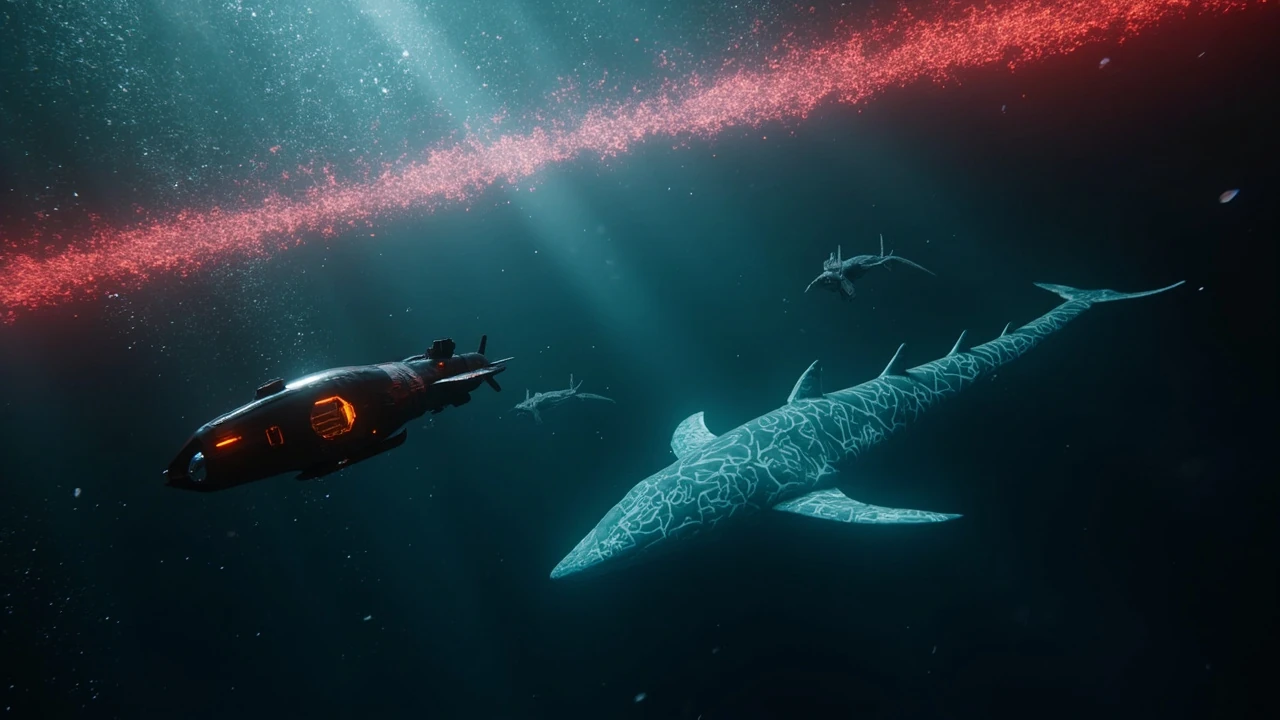
The Shiver Leviathan sits at the unfinished edge of Subnautica 2’s Early Access map. A current IGN wiki entry on where to find the creature describes it as the deadliest organism in the alien ocean, with the ability to kill a player in one hit, even inside an upgraded submersible. The same source confirms that the encounter is structured as a pack of three animals, with a larger female flanked by smaller males that detach to attack. That pack geometry, the red holographic wall that bounds the playable biomes, and the creature’s role as a soft world barrier together form a useful case study in how survival games turn unfinished content into deliberate player experiences.
This article treats the Shiver Leviathan as both a gameplay element and a design object. It walks through the documented behavior, the spawn logic that ties it to the Void, the pack pattern that elevates the threat, the production reasoning behind using a one-shot creature as a world edge, and the lessons the encounter offers other studios building open-world or survival systems where world limits, content under construction, and player risk have to coexist.
What the reference page actually documents
Before drawing conclusions, it helps to anchor what the source actually says, because the page is short and specific rather than a full bestiary entry. The Shiver Leviathan is described in four claims that anchor the rest of the analysis.
- It is the deadliest creature currently documented in Subnautica 2 and belongs to the Leviathan class of organisms.
- It can instantly kill the player in a single hit, including inside an upgraded Tadpole submersible.
- It is tied to the Void, the area outside the playable Early Access biomes that the developers have not finished.
- It serves as a soft barrier that prevents the player from leaving the designed play space while the world is being built.
Two details matter for everything that follows. First, the lethality is not gradual; it is a one-shot rule rather than a damage-over-time system, and there is no armor tier or upgrade that prevents it. Second, the trigger is environmental, not quest-based, which means a curious player can run into the creature without following any narrative breadcrumb. The creature is the boundary, and the boundary is the creature. Anything written about a health bar, a stun window, a weakness element, or a drop table would extend past what the source actually supports, so this article deliberately leaves those questions open.
The Void, the red wall, and the moment of contact
Subnautica 2’s Early Access map is fenced by a visual and mechanical signal. The reference describes a holographic red wall that marks the edge of the playable biomes. Crossing that wall does two things at once: it teleports the player’s camera into the Void, and it summons the Shiver Leviathan on the spot.
From a systems standpoint, this is a clean implementation. The developers did not need a separate invisible collision mesh, a loading screen, or a forced return-to-safe-zone trigger. The visual cue, the narrative cue, and the death cue are routed through the same moment. The player ignores the warning, crosses the wall, the threat arrives on screen, and the encounter resolves in seconds.
For open-world and survival teams, the pattern is worth studying because it does three jobs with one mechanic, and each of those jobs maps to a real production pain point.
- It marks unfinished content without hiding it behind a black screen or a fade-to-load.
- It gives players who push the boundary a memorable, story-worthy death instead of a generic “you cannot go here” message.
- It turns what would otherwise be a developer-side limit into a piece of worldbuilding that fits the fiction of an alien ocean with territorial giants.
The source also notes that the pack appears as soon as the player enters the Void, which suggests the spawn is keyed to the act of crossing the wall itself rather than to a timer, a distance check, or a heat map. That single-frame trigger makes the encounter predictable for QA and consistent for players, which is exactly the property you want from a boundary system.
Pack structure: one female, two males, one hunting pattern
The Shiver Leviathan is not a single monster encounter. The reference page describes a trio: a larger female flanked by smaller males that stay attached to her body, then detach when the pack commits to the player. Once the males break formation, the source is explicit that there is no safe exit.
This pack geometry does several things that a solitary creature would not achieve as cleanly, and they translate directly into the player’s first read of the scene.
- It communicates a family or social structure at a glance, which deepens the world without any dialogue, codex entry, or audio log.
- It creates a beat of false safety, because the males read as ornamental or juvenile until they begin to move on their own.
- It escalates the chase from a single threat into a converging threat, which forces the player to make a decision in seconds rather than play out a long duel.
- It provides natural variety on a single skeleton, since the team can scale, animate, and tune the male and female forms differently without authoring a second species from scratch.
For technical artists and AI designers, the takeaway is that a small, well-differentiated pack is often a more effective system than a single oversized monster. A solo creature with very high hit points turns the encounter into a stat check that the player either passes or fails based on loadout. A pack of differentiated actors turns the encounter into a spatial puzzle, because the player has to read the formation, predict which agent will commit, and find a direction that does not run into the others. Even in a two-second encounter, that read is what makes the moment feel like a scene instead of a damage formula.
Why a one-shot creature works as a world edge
Instant-kill enemies are usually a bad fit for most games, because they cut off the learn-by-failing loop that survival design depends on. The Shiver Leviathan survives that criticism because the game never asks the player to fight it. The reference is explicit that the creature is guarding the Void, and that going out of bounds is what summons it. The encounter is the consequence of crossing a clearly marked line, not a random spawn in a normal biome.
This separation between combat enemies and boundary enforcers is a useful design pattern. A combat enemy has to be balanced, telegraphed, and given counterplay so the player can win a fair fight. A boundary enforcer only has to be memorable, legible, and consistent so the player can choose not to start the fight. Subnautica 2 leans on the Shiver Leviathan for the second job, which is why its one-shot rule feels appropriate rather than punishing.
Three implementation details help this work in practice, and each one is something a small team can ship on a tight Early Access schedule.
- The red holographic wall telegraphs the boundary before the creature appears, so the player has a visual cue to read from a distance.
- The creature spawns at the moment of crossing, so the response is immediate and impossible to miss.
- There is no respawn or chase back into the safe zone in the documented behavior, which keeps the boundary predictable for players who test it more than once.
The same source flags an open question that is itself instructive. Once Subnautica 2 leaves Early Access and there is no longer a Void to protect, the Shiver Leviathan will need a new role, and the reference is candid that the full release is still some distance away. That uncertainty is worth preserving in any design discussion, because it shows that even a tightly designed encounter is tied to the production phase of the game around it, and a creature that makes sense today may not make sense the day the Void disappears.
How the encounter maps to common open-world boundary patterns
Open-world games handle the edge of their maps in a handful of recurring ways. The Shiver Leviathan encounter sits inside a recognizable family, and comparing it to those patterns clarifies what makes it distinctive without inflating its originality.
| Boundary pattern | Player experience | How the Shiver Leviathan compares |
|---|---|---|
| Invisible wall with no fiction | Frustrating, breaks immersion, often patched with hidden justifications later | Not used here; the creature provides explicit fiction for the limit |
| Environmental damage (cold, radiation, depth) | Slow, readable, encourages retreat before death | Not used here; the encounter is instant, not a damage ramp |
| Narrative barrier (blocked door, sealed cave) | Calm, focuses curiosity on the locked side | Not used here; the barrier is hostile, not a puzzle |
| Hostile boundary creature with a clear visual marker | Unforgettable, ties limit to a named threat, doubles as worldbuilding | This is the Shiver Leviathan pattern |
| Loading screen back to safe zone | Functional but disorienting, removes the player’s agency at the edge | Avoided; the player makes the choice and pays for it in-fiction |
The comparison makes the design choice obvious. Most boundaries in the table feel like an interruption in the player’s flow, and players tend to remember them as friction. The Shiver Leviathan boundary feels like a scene, which is a higher bar to clear and a useful target for studios that have to ship a world before it is finished.
Reading the encounter as a producer
Reading the creature as a developer rather than as a player makes a different set of constraints visible. The supplied reference frames the situation plainly when it notes that the Void is the area the developers are still building, which means a boundary creature has to do work that a finished biome would otherwise do, and it has to do that work with limited content.
That pressure shaped the creature in three practical ways that show up in the shipped behavior.
- The visual identity is strong enough to feel like a deliberate addition to the world rather than a debug placeholder, which preserves the fiction of the alien ocean.
- The encounter is short and decisive, which keeps production cost low and avoids spending finished-state art on a region the player is not supposed to reach.
- The behavior is consistent across all three pack members, which simplifies AI tuning and lets the team iterate on the encounter without testing many variations.
For studios running live or early access projects, the lesson is that boundary content is still content. Treating it as a craft problem rather than a clip-volume problem pays off in player trust, because a clean, intentional death at the edge of the map reads as confident design, while a glitched out-of-bounds slide or a generic error message reads as a game that ran out of time. The Early Access audience is unusually good at spotting which side of that line a studio is on, and a creature like the Shiver Leviathan is a relatively cheap way to land on the right side.
What a pack encounter looks like under the hood
Although the reference page does not break down the AI state machine, the described behavior gives enough information to sketch a plausible implementation pattern. The pack spawns as a group on a boundary event, holds formation around the female, releases males on player detection, and converges. That sequence is short, which is friendly to runtime cost, and it is also forgiving of animation polish, because the player only sees a few seconds of action before the encounter resolves.
For teams modeling similar encounters, the production checklist usually looks like this, and the Shiver Leviathan is a clean case study in how each item can be kept simple.
- Define the trigger as a single environmental event, such as a volume entry, rather than a chain of conditions. This keeps the spawn deterministic and easier to debug, which matters when the trigger is on a boundary that QA will test repeatedly.
- Author the formation once, then expose offset variables for the male slots. This lets designers reposition the males without reauthoring the entire pack, and it keeps the trio reading as a single creature on first glance.
- Keep the attack decision centralized on the female, with the males reading a “release” signal rather than each running their own detection logic. This avoids three creatures colliding in the same target slot, which is a common failure mode for early pack AI.
- Match the audio sting to the moment of crossing the wall, not to the moment of death. The reference notes an unsettling roar as the player enters the Void, and that timing is the correct one: it warns rather than punishes, and it gives the audio team a single high-impact cue to mix instead of a layered sting.
None of these are unique to Subnautica 2, and any one of them has been done in isolation by other survival and horror games. What the Shiver Leviathan demonstrates well is how a small amount of polish, applied at the right moment, can carry a short encounter that the player will still remember a year later. A practical look at the spawn and combat behavior on a reference page like the Subnautica 2 wiki entry on the Shiver Leviathan shows how compact the documented behavior actually is, and how much of the design weight is carried by timing and formation rather than by complex systems.
Lessons that transfer to other survival and open-world projects
There is a recurring pattern in survival design where unfinished content gets masked with invisible walls, fade-outs, or “you cannot go that way” text. The Shiver Leviathan is a more ambitious solution to the same problem, and the lessons transfer to other projects even if the creature itself does not.
The first lesson is that the boundary deserves a character. If a player is going to remember the edge of the map, that edge should have a face, a sound, and a reason for being there. A nameless kill volume produces a forum post complaining about the wall. A named creature produces a story the player tells their friends, and that story does the marketing work that an Early Access roadmap cannot.
The second lesson is that the warning should match the consequence. The red holographic wall and the roar are the warning; the instant kill is the consequence. Because the two are calibrated to each other, the player has the information needed to make the choice, even if the choice is still fatal. That calibration is the difference between fair difficulty and cheap surprise, and it is the single most important thing a boundary encounter can get right.
The third lesson is that boundary creatures can carry worldbuilding for free. The pack geometry, the female-and-males dynamic, and the territorial role all add to the fiction of the alien ocean without requiring quest text, codex entries, or cinematics. Designers who want a denser world without a denser script budget can study encounters like this and borrow the technique, and the savings show up directly in the schedule.
The fourth lesson is to plan the encounter’s second life. The reference is candid that the Shiver Leviathan’s role will change once the Void no longer exists. A team that treats a boundary creature as a one-phase solution risks needing to redesign it later, often under the additional pressure of a launch window. A team that plans a post-Early Access role for the creature from the start gives itself a smoother transition when the world finally fills in, and the Shiver Leviathan is a useful example of an encounter whose current job and future job are both worth thinking about early.
Player-side checklist for approaching the boundary
Most players will not be designing a pack creature, but they will want to know what to do when they see the red holographic wall. The reference page is explicit that the encounter is not a fight, so the checklist is short, and the right mindset is closer to a safety briefing than to a loadout guide.
- Treat the red holographic wall as a hard line. The visual signal is the only warning the game gives in the documented behavior, and it is reliable across runs.
- Do not chase the roar. The sound is a cue that the pack has already spawned, and the female is already in the distance.
- Do not expect the upgraded Tadpole to save you. The reference states that an upgraded submersible does not prevent the instant kill.
- Plan a return route before crossing, because the encounter resolves in seconds and there is no documented recovery window once the males have detached.
Players who want a screenshot or a story will get one either way. Players who want a clean death with a clear cause will get that too, which is unusual for a boundary encounter and worth appreciating on its own, because most world edges in open-world games are designed to be ignored rather than remembered.
What the source does not tell us, and why that matters
| Open question | What it would change if answered |
|---|---|
| Will the Shiver Leviathan’s territory move to a new region once the Void is gone? | Decides whether the creature stays canonical or gets replaced by a successor boundary predator. |
| Will the trio of one female and two males remain the canonical formation? | Sets whether future patches treat the pack as a fixed system or an evolving one. |
| Will the instant-kill rule survive the transition out of Early Access? | Determines whether the encounter stays a hard boundary or gains counterplay. |
| Will the red holographic wall remain in the final game? | Changes the visual signal players rely on to read the world’s edge. |
The reference is honest about what it does not know. It says the Shiver Leviathan may play a larger role in Subnautica 2 once the game leaves Early Access and there is no longer a Void to protect, but that the full release is still some distance out. A careful read of the source should not fill that gap with speculation, because doing so would turn a documented Early Access encounter into fan fiction. The right move is to state the open questions and the kind of official information that would resolve them.
- Will the Shiver Leviathan’s territory migrate to a new region of the map, or will a different creature take over the boundary role once the Void is gone?
- Will the pack size and composition change, or will the trio of one female and two males remain the canonical formation?
- Will the instant-kill rule persist once the encounter is no longer tied to a developer-side limit, or will it be tuned to allow counterplay?
- Will the red holographic wall remain in the final game as a piece of legacy worldbuilding, or will it be replaced by a finished biome that the player can actually explore?
Each of those questions is something a developer or a producer could answer with a single design decision, and several of them will probably be answered in patch notes long before the game’s full release. Until they are, the safest framing is to describe the creature as it is documented today and leave the post-Early Access role open, which is the position the reference itself takes.
Where the Shiver Leviathan fits in the wider Leviathan class
Subnautica 2 uses the Leviathan label for its largest and most dangerous fauna, and the Shiver Leviathan is described as belonging to that class. The label is more than flavor text. It tells the player that the encounter is part of a recognized family of threats, which gives the world a sense of taxonomic order without requiring a codex screen.
From a design perspective, labeling the creature as a Leviathan does two things at once. It signals that the player should treat it as an environmental hazard rather than a huntable target, and it sets expectations about scale, sound, and behavior. Players who have seen other Leviathan-class creatures in the series will transfer those expectations to the Shiver Leviathan on first sight, which is a free bit of design literacy that the developers do not have to teach through tutorial text or audio logs.
For studios building their own fauna hierarchies, the broader lesson is that taxonomy is a design tool. Naming a class of threats and then placing a creature inside that class gives designers a vocabulary for tuning encounters. A Leviathan is allowed to be lethal, loud, and territorial because the class says so. A smaller predator in the same world is not, because the class would be a lie. The Shiver Leviathan lives up to its label, which is part of why the encounter reads correctly even on the first frame, before the player has any context for who or what is on the other side of the red wall.
Why the encounter reads as fair even though it is not a fight
It is worth spending a moment on the feeling of the encounter, because the design choices above only matter if the player experiences them as fair. The Shiver Leviathan is lethal, unavoidable, and one-shot, which on paper sounds like the worst kind of game design. In practice, the encounter reads as fair because the game gives the player every signal it can before the kill.
The red wall is visible from a long distance, which means the player has time to slow down and read the environment. The roar arrives as the player crosses the wall, which means the audio cue and the visual cue are synchronized. The female appears in the distance before the males detach, which means there is a brief window where the threat is being set up rather than already in motion. None of that prevents the death, and the source is clear that the death is the point. It does, however, give the player the one thing that an unfair encounter takes away: the sense that the death was their choice and their reading of the scene, rather than a hidden trigger or a miscalculated jump.
That is a hard thing to design for, and it is the reason the encounter has generated the kind of word-of-mouth reaction that Early Access projects depend on, even when the creature only shows up at the very edge of the map.
What to watch for in future patches and updates
Because the Shiver Leviathan is tied to a production phase, the encounter is also a useful barometer for how the rest of the world is filling in. Players who want to track the boundary as a signal rather than as a destination can keep an eye on a few concrete things in patch notes and dev streams.
- Any change to the red holographic wall, including its color, its position, or its removal, will signal that the Void behind it is being worked on or replaced.
- Any change to the pack composition, such as a different number of males, will signal that the team is iterating on the encounter itself rather than on the area around it.
- Any change to the audio cue, especially the roar, will signal a shift in how the developers want the moment of crossing to feel, and that is usually a leading indicator of a larger content drop.
- Any new Leviathan-class creature documented in patch notes is worth comparing to the Shiver Leviathan, because the developers will almost certainly reuse the boundary pattern in some form.
None of these are guarantees, and the reference page does not promise that any of them will happen. They are the kind of secondary signals a player can use to keep an Early Access roadmap in focus, which is the same posture the source itself takes toward the creature’s future role.
Frequently asked questions
What is the Shiver Leviathan in Subnautica 2?
The Shiver Leviathan is a Leviathan-class creature in Subnautica 2 that currently serves as the guardian of the Void. According to a current IGN reference, it is described as the deadliest creature in the game and is capable of killing the player in a single hit, even inside an upgraded Tadpole submersible.
Where do you find the Shiver Leviathan?
You find the Shiver Leviathan outside the playable Early Access biomes, beyond a red holographic wall that marks the boundary of the designed map. Crossing the wall teleports the player into the Void and summons the creature, so reaching it is a matter of pushing the boundary rather than following a quest marker.
Can the Shiver Leviathan be avoided once it spawns?
The reference page indicates there is no documented escape once the creature has the player in its sights. The pack spawns immediately, the males detach from the female, and the attack resolves quickly. Avoidance is about not crossing the wall in the first place, which is the only stage of the encounter where the player has real agency.
Does the Shiver Leviathan travel alone or in a pack?
It travels in a pack of three. The reference describes a larger female flanked by smaller males that remain attached to her body until the encounter begins, at which point the males detach to attack, which is the structural detail that turns the moment from a single threat into a converging one.
Can an upgraded submarine survive a Shiver Leviathan attack?
No. The supplied reference states that the creature can instantly kill the player even when they are piloting an upgraded Tadpole. The encounter is designed to be lethal regardless of vehicle tier, so the choice of submarine does not change the outcome.
Why does the Shiver Leviathan exist in Early Access?
It exists because the map is unfinished. The Void is the area the developers are still building, and the creature acts as a soft barrier that prevents the player from leaving the playable region while still giving that boundary a place inside the game’s fiction, which is a more ambitious solution than a typical invisible wall.
Will the Shiver Leviathan change after Early Access?
The reference page suggests the creature may play a larger role in Subnautica 2 once the game leaves Early Access and there is no longer a Void to protect. No specific post-launch role is documented yet, so the safest framing is to treat the current behavior as a snapshot of Early Access design and watch future patch notes for any change to the red wall, the pack, or the audio cue.
Is the Shiver Leviathan the strongest creature in Subnautica 2?
Within the documented Early Access content, the reference describes it as the deadliest creature currently in the game. That description is scoped to what is available now and should not be treated as a permanent ranking of every Leviathan-class organism in the final release, because new biomes and new creatures are still in development.
What audio cues does the Shiver Leviathan give?
The reference describes an unsettling roar that the player hears as soon as they enter the Void. The roar arrives with the visual cue of the creature appearing in the distance, which gives the player a split-second warning before the attack, and that synchronization is one of the design choices that makes the encounter feel calibrated rather than random.
What can other survival games learn from the Shiver Leviathan encounter?
The encounter shows that a boundary creature can replace invisible walls, that the warning should match the consequence, that pack geometry adds depth without adding content, and that boundary encounters deserve a planned post-Early Access role. These are useful patterns for any studio that has to ship a world before the world is finished, and they are the reason the Shiver Leviathan is worth studying as a case rather than only as a monster.




Leave a Reply