
Vigilante peacemaker: what the phrase actually points at
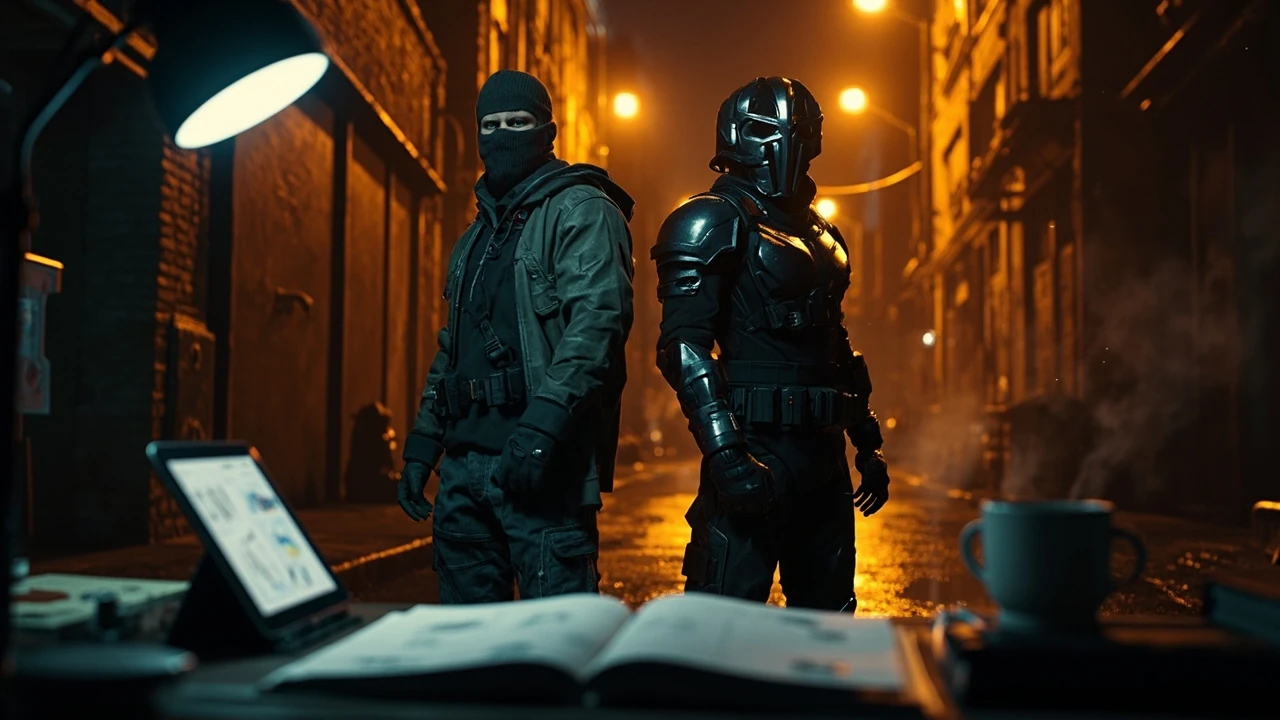
The phrase “vigilante peacemaker” gets used in three different ways online, and most of the confusion in fan wikis, Reddit threads, and concept pitches comes from mixing them up. There is the DC Comics character Christopher Smith, who fights crime under the name Peacemaker and was redefined for a streaming series. There is the separate DC character Adrian Chase, the Vigilante, who has been rewritten several times since the 1980s. There is also a general descriptive reading in which any self-appointed “peacemaker” who operates outside the law is labelled a vigilante, the way some news outlets describe masked or off-book interventionists. The most useful reading for game developers, narrative designers, and licensors is the first two, because the named characters already share a continuity and have crossed over in print and on screen.
For game design purposes, the duo of Vigilante and Peacemaker is interesting precisely because they sit on opposite sides of the same moral line. Peacemaker is willing to kill for peace. Vigilante, in his more popular modern reinterpretation, is a bumbling violence-seeker who thinks he is helping. That tension is rare in licensed properties: you have two characters with overlapping rosters, similar power scales, and a confirmed on-screen relationship, who nevertheless encode completely different design philosophies. Anyone building a licensed brawler, a co-op action game, or a narrative spinoff has to decide which version of the dynamic they want, because the mechanics that work for one will flatten the other.
That decision is harder than it looks, because the actual canon leaves wide gaps. The most explicit current source on the pair as a unit is the limited comic miniseries that bridges the two seasons of the streaming show, in which Vigilante operates as Peacemaker’s well-meaning but unreliable deputy while Peacemaker is away. The series makes clear that Vigilante does not understand Peacemaker’s absence, fills the void by attacking criminals on his own, and ends up in a plot built on a misread clue. The pair is written as a comic engine, not as a balanced duo, and that fact shapes every game adaptation choice that follows.
Why the duo keeps getting pitched as a co-op setup
Studios keep circling Vigilante and Peacemaker for co-op or team-up projects because the surface-level pitch is strong. Two mask-wearing, blunt-force characters with overlapping threat profiles give an artist room to design a varied moveset, a level designer room to gate progression behind two abilities, and a writer room an obvious source of banter. None of those reasons require the characters to mean anything in particular, which is usually the first warning that a licensed pitch is going to feel hollow. The trick is to keep the marketing surface while reading the actual source closely enough to know what the dynamic is doing.
The comic series between the two show seasons is a useful reference here, because it does not pretend the duo is balanced. Vigilante is faster, louder, and consistently wrong about the situation. Peacemaker, when he appears at all, is calm, decisive, and prepared to escalate. A co-op game built around that asymmetry has to give each player a different job, not just a different skin. If both characters play the same way, the writing is wasted; if one character is mechanically weaker, the writing is undermined.
There is also a recurring production problem: any licensed project has to choose between fitting inside the existing canon and standing alone. A new co-op game can sit adjacent to the show without contradicting it, or it can fill in a gap the show has not covered. The comic’s own existence is an example of the second approach, and it only works because the gap it fills (the time between the two seasons) is narrow and well-defined. A game cannot safely invent a parallel gap that large, because the show may eventually cover that ground and overwrite whatever the game does.
Character design problems hidden inside the brand
The hardest part of designing for either character is that both have been rewritten several times. Peacemaker, as a name, has existed in DC continuity since the 1960s, but the version most players recognise is the 2020s television version, who behaves very differently from the 1980s comic version of the same name. Vigilante has had at least three distinct civilian identities and a range of moral alignments. A game team that picks “Vigilante” without picking a version is picking nothing.
The most useful exercise is to write down, per character, which version is being used, what their power scale is in that version, what their moral logic is, and which relationships the team is allowed to reference. The official character bible for the streaming show is not publicly available to independent developers, which means a small studio is essentially designing against the on-screen version as their source of truth. That has consequences: anything in the show that was improvised, scripted last-minute, or contradicted by deleted scenes cannot be safely treated as canon for a game.
A second design problem is costume readability. Peacemaker’s helmet, in particular, is doing a lot of work visually but limits facial animation and reduces the camera angles that read clearly. Vigilante’s looser outfit is more flexible but reads as lower-threat, which conflicts with his actual combat behaviour. If a team is building a hero shooter, the silhouette test matters more than it does for a single-player narrative game, and these two characters stress the test in opposite directions.
Game design angles that actually fit the duo
The duos that work in licensed games tend to share a clear mechanical difference. A co-op brawler can be built around one character who is a heavy single-target killer and another who is a mobile area controller. The problem with applying that template to Vigilante and Peacemaker is that Peacemaker already does the heavy single-target killer job, and the modern Vigilante does not. The result is that a careful designer either has to soften Peacemaker so Vigilante can keep up, or push Vigilante into a role the source material does not support.
A more honest reading is to lean into the asymmetry. The comic positioning has Vigilante as the instigator and Peacemaker as the closer. A level could play out with the player controlling Vigilante through a sequence of mistakes that alert every enemy in the area, then switch to Peacemaker for the disciplined clear-up. That works for a single-player game with a defined partner, but it is a hard pitch for a live-service co-op title where players expect to feel competent at all times.
There is also a stealth angle that the comic makes unusually available. Vigilante, in his current version, is not particularly good at staying unseen, but Peacemaker’s usual approach in the show involves planning, recon, and intimidation. A two-character stealth game with Vigilante as the loud scout and Peacemaker as the quiet finisher is mechanically coherent and matches what little canonical material actually shows. It is also a smaller-scope idea, which is often what an independent studio can actually finish.
Narrative traps when adapting a duo
The biggest narrative trap is treating Vigilante as a straight man. His current on-screen portrayal is defined by a mismatch between his stated beliefs and his actual competence, and the comedy comes from the gap. A game that flattens that gap will look like it is missing the point. A game that leans into the gap has to be careful that the player is invited to laugh with the character, not at him, because licensed work is watched closely by the audience that already cares about these characters.
The second trap is violence scale. Peacemaker operates at a body-count level that requires either careful framing or a clear fictional distance. A grounded, near-future game can carry that, but a game that tries to be tonally bright will struggle. Vigilante’s looser morality softens this slightly, but only slightly, and a writer who uses his levity to justify a higher body count is solving a ratings problem with character rather than design.
The third trap is Eagly, the animal sidekick, and other adjacent characters that a show built up. For additional context, Eagly is a fan-favourite element that any adaptation will be pressured to include, but a live eagle is a hard mechanic to design around. Studios that have tried animal companions in licensed games have a mixed record, and Eagly’s role in the show is part combat, part emotional anchor, and part visual gag, which is a wider brief than most systems can support.
Where the canon leaves real gaps
The single most useful thing the limited comic series does for a game team is confirm that the showrunners are willing to publish canon material that exists between the two seasons. That matters because it means there is a real, narrow window in which an original game could plausibly be set without stepping on the show’s narrative. The series is short, clearly scoped, and only covers a few plot beats, so the surrounding time is not overdetermined.
What the canon does not provide is a clean list of abilities, a confirmed power scale, or a reliable set of supporting cast roles. The show is the closest thing to a reference, but it is also a moving target, because new material is still being released and editorial direction can change between seasons. A game team that builds a tight mechanical loop on top of a character whose canon is in flux has to accept that the loop might need to be re-cut when new material is published.
For independent developers without a license, the canon gaps are not a problem in the same way. The brand surface is what carries the pitch, and the gaps in canon mean there is room to write original stories. The risk is that a non-licensed project that leans too hard on the brand surface will be picked apart by the existing fan base. The right framing is usually “inspired by” rather than “based on,” with original characters and clear visual differentiation.
Production constraints a small team should plan around
The most expensive part of a licensed project is usually not the art. It is the legal review, the brand alignment process, and the contingency budget for changes that arrive late. Independent teams that are pitching these characters to a licensor should plan for at least one full pass of mechanical changes after a brand review, because licensors frequently insist on altering combat outcomes, civilian behaviour, or signature moves to avoid contradicting the source. Building a system that can absorb that without a full rebuild is itself a design task.
A second constraint is motion capture. Both characters are defined as much by movement as by costume. Peacemaker’s walk, his helmet tilt, and his specific brand of hand-to-hand choreography are doing real character work. Vigilante’s looser, slightly chaotic movement is also a signature. A team that animates either character with generic mocap will produce something that reads as off to anyone who knows the source, and the cost of replacing that animation late is high. A cheaper alternative is to design the characters around stances, weapons, and camera framing that hide the limitation, but that constrains the rest of the game.
A third constraint is audio. The voice work for the streaming version is widely recognised, and any licensed project is going to be compared against it. Most small studios cannot afford to recapture the original actor, and the legal path to doing so for a game is not always open. This pushes smaller projects toward original dialogue, original tone, and an original voice cast, which is a fine choice if it is taken early and on purpose.
Engine and technical decisions for a duo project
From a technical standpoint, a two-character action game is not twice the work of a single-character game, but it is more than one-and-a-half times the work, because the systems have to support both characters cleanly. Animation, input mapping, ability scripts, and damage handling all need to be designed to accept a second character without a rewrite. This is the kind of decision that is cheap to make early and expensive to make late.
For an Unreal-based project, the two-character problem is mostly a question of how the Animation Blueprint, the Gameplay Ability System, and the AI perception graph are set up. The pattern that usually survives a brand review is a shared skeleton with character-specific AnimBPs, a single GAS-driven ability framework, and a perception setup that supports both close-combat and ranged behaviour. For a Unity-based project, the equivalent decisions sit inside the animation controller, a custom ability framework, and a behaviour tree that can be parameterised per character.
A useful diagnostic is to ask whether a designer can swap a placeholder character into one of the two slots without breaking combat, AI, or cinematics. If the swap breaks something, the abstraction is too thin and a future character (which the licensor may add or require) will trigger a rewrite. The same diagnostic works for both small teams and larger studios, because the failure mode is the same regardless of scale.
Monetisation, platforms, and player expectation
Licensed action games have a wide range of commercial outcomes, and the difference is usually expectation management. A premium single-player game that ships close to a season’s release is read as a tie-in. A live-service game that ships later is read as a competitor. A co-op game that needs two players to play well is a hard sell on console, where split-screen and online friend activity are uneven. None of these are reasons not to ship, but they shape the marketing brief and the launch window.
Platform certification is its own constraint. The tone of the source material makes a clean ESRB or PEGI rating more likely than a violent rating, but the on-screen behaviour of the characters, especially Peacemaker, is at the edge of what rating boards accept without a content lock. A team that is targeting a Teen rating should plan their kill animations, blood effects, and aftermath framing early, because a late change to those systems is a multi-week effort and a certification risk.
Monetisation for a licensed duo project is also narrower than it looks. Cosmetic microtransactions are viable because both characters have visible costume elements. New characters as paid DLC are a common model but depend on the licence agreement. A battle pass that includes the source characters is usually a licensor decision, not a developer decision, and a team that designs a battle pass without confirming that the licensor will allow it is designing on top of an unresolved contract term.
Comparison table: design fits for a Vigilante-Peacemaker duo game
| Design angle | Source fit | Scope for a small team | Main risk |
|---|---|---|---|
| Asymmetric co-op brawler | Strong: matches duo’s different combat roles | Medium: needs two full movesets and balance pass | Players feel one character is weaker and reroll |
| Single-player narrative with AI partner | Very strong: matches the show’s writing voice | Low to medium: one moveset, partner scripting | AI partner must read well or it breaks tone |
| Stealth-action two-character swap | Good: matches Peacemaker planning, Vigilante chaos | Low: short levels, two toolkits, no live balance | Stealth fans expect one toolkit, not two |
| Top-down twin-stick | Weak: hides costume and animation work | Low: small team can ship a vertical slice | Loses the character readability the source sells |
| Hero shooter class pair | Medium: rosters fit a class system | High: live balance, large maps, ongoing ops | Licensor may want a third canon class to fill the roster |
| Visual novel with QTE combat | Medium: lets dialogue carry the dynamic | Low: art and writing dominate the budget | Fans expecting action may feel underserved |
Comparison table: source material and what each gives a game team
| Source | What it confirms | What it leaves undefined | Game adaptation use |
|---|---|---|---|
| Streaming show, season one | Character voice, costume design, basic abilities, supporting cast | Full power scale, in-universe rules for the helmet, exact relationship with Vigilante | Primary reference for tone and combat framing |
| Streaming show, season two (if applicable at the team’s development date) | Updated status, possible new cast, possible new tonal direction | Long-term canon, future of the duo | Check before locking final scripts; do not design against unverified rumours |
| Peacemaker Presents limited comic | Vigilante operates without Peacemaker for a stretch, the duo is asymmetric, the gap between seasons is usable for original stories | Canonical outcomes, exact sequence of events outside the comic | Best reference for an inter-season gap game |
| Earlier Peacemaker comics | The name has existed in DC continuity for decades | Whether the show version is meant to align with any specific earlier run | Avoid for ability design; the show is the operative reference |
| Earlier Vigilante comics | The name has had multiple identities and alignments | Which identity the show version is meant to reflect | Use only for atmospheric reference, not for ability design |
Decisions a producer should make before greenlight
The decisions that actually change the shape of a project sit earlier than most teams realise, and a Vigilante-Peacemaker duo project has more of them than a single-character project. A producer who locks the following decisions before the design document is written will save the team a lot of rework later.
- Which version of each character is the source of truth, and which run of each character is being treated as canonical for the game.
- Whether the game is set between show seasons, in an alternate continuity, or in a fully original setting that is “inspired by” the brand surface.
- Whether the project is single-player, local co-op, online co-op, or live-service, because the answer changes the balance budget, the animation budget, and the certification path.
- Whether Eagly or other show-specific supporting elements are in or out, because each one is a real design and animation cost.
- What the licensor’s review process is, and how many design passes the budget actually allows for.
- Whether voice work will be original or licensed, and whether the original cast is available at all.
- What the rating target is, because a Teen target changes combat framing and a Mature target changes the marketing brief.
Risk register for a licensed duo project
A risk register does not have to be formal, but it has to be honest. The risks below are the ones that most often sink projects of this shape, and they are ordered by how late they tend to surface relative to how expensive they are to fix.
- Late brand-review change to a signature ability, which forces a moveset rebuild at the worst possible point in production.
- Voice cast change between greenlight and ship, which forces a re-record, a re-anim, or a change of marketing language.
- Show announcement that contradicts a key game plot point, which forces a rewrite under time pressure.
- Rating board escalation, which forces a frame-by-frame pass over the most expensive cutscenes.
- Online co-op platform certification failure, which can force a delay or a feature cut that changes the marketing position.
- Platform holder policy change, especially around licensed content, that adds a review step the project did not budget for.
- Engine or middleware update that breaks the ability or animation framework after the systems are mostly built.
How to validate the concept before writing the design document
A team that wants to know whether the duo carries a game should run a small, focused validation pass before the design document is finished. The goal is to answer three questions: does the duo’s dynamic support a real mechanical loop, does the audience recognise the dynamic, and is the licensor likely to allow the mechanical loop. The third question is the one most independent teams skip, and it is the one that matters most for budget.
The cheapest validation is a paper prototype. Pick three combat situations from the comic, sketch the two characters’ responses to each, and check whether the responses are different enough to feel like two characters and similar enough to feel like a team. If the paper version does not work, the full game will not work either, and the team can pivot without writing code.
The next step is a one-week prototype in-engine, using placeholder characters, to test the loop. This is the point at which most teams find that the dynamic they wanted needs adjustment. The two characters’ abilities should be designed so the loop is fun with placeholder art, because if it is not fun with placeholders, art will not save it. The prototype should also be shown to at least one person who knows the source well, because fan reaction at launch is the variable that most often surprises licensed projects.
The licensor question is harder. A team that does not already have a relationship with the rights holder should not spend significant budget before getting at least an indication of interest. That is not the same as a signed deal, but it is a useful signal that the project will not be blocked at the licensing stage. Studios that skip this step sometimes finish a vertical slice only to find that the licensor is committed to a different partner for the next two years.
Frequently asked questions
What is the difference between Vigilante and Peacemaker?
Vigilante and Peacemaker are two separate DC characters who share a setting and a working relationship. Peacemaker’s defining trait is that he is willing to use lethal force in pursuit of peace, while the modern on-screen version of Vigilante is defined by a mismatch between his stated beliefs and his actual competence. In the current streaming continuity, the duo functions as a comic engine: Peacemaker is the planner and closer, Vigilante is the instigator and the source of escalation. Earlier comic versions of both characters are quite different, so any adaptation that mixes the older runs with the current on-screen version is making a design choice that should be flagged in the brief.
Is Vigilante Peacemaker’s sidekick?
Not in the strict traditional sense. The current on-screen dynamic treats Vigilante as an adult partner who acts independently, often in situations Peacemaker has not authorised. The comic series between the show’s two seasons shows Vigilante operating as if he is deputising for Peacemaker, but without the operational discipline that implies. A game team that wants to use the “sidekick” framing has to be careful, because the source material leans on the gap between what Vigilante thinks his role is and what is actually happening, and a flat reading will lose the tone.
Can an independent studio use the Vigilante and Peacemaker characters?
Only with a license from the rights holder, which is Warner Bros. Discovery through its DC and television properties. Independent studios sometimes build “inspired by” projects that use clearly different characters and visual codes, and that path does not require a license, but it does require that the project not be confused with the source. Pitching the brand surface to a licensor before any public work is the safer path, and a project that publishes screenshots or a vertical slice before clearing rights can be asked to take the work down.
What kind of game suits the duo best?
A single-player narrative with an AI-controlled partner is the most faithful read of the source, because the show’s dynamic depends on a writing voice that a co-op session cannot reproduce without careful scripting. Asymmetric co-op is a strong second, provided the two characters are mechanically distinct enough that both players feel competent. Stealth-action with a two-character swap is a smaller-scope idea that fits the duo’s planning versus chaos dynamic, and it is realistic for a small team to finish.
What power scale should a Vigilante-Peacemaker game use?
The show’s current version is grounded-superhero, with both characters operating at peak human plus signature gear. A game that pushes them into cosmic or metahuman territory is making a different choice, and that choice has to be flagged to the licensor before any abilities are designed. Most licensed work of this shape stays in the grounded range, because that is where the violence scale and the costume readability both hold up.
How should a team handle Eagly in a game adaptation?
Eagly is a fan-favourite element that any adaptation will be pressured to include, but a live eagle is a hard mechanic. Teams that want Eagly in the project should treat it as a system with a real budget: animation set, AI behaviour, cinematics integration, and a way to integrate Eagly into the combat and traversal systems without overshadowing the two leads. Teams that cannot afford that budget should plan for an original replacement early, so the design does not depend on a feature that will not ship.
What is the safest canonical window for an original game story?
The narrowest, safest window is the time covered by the limited comic between the two show seasons, because that period is confirmed to exist and is not overdetermined by the show itself. Outside that window, a game has to either set itself in an undefined stretch of time (which is fine, but requires careful copy to avoid contradicting future show content) or in an original continuity (which avoids the canon problem but creates a brand-surface problem).
Should a Vigilante-Peacemaker game be single-player or co-op?
Single-player is the lower-risk path, because it does not depend on a second player feeling engaged, and it lets the writer control the duo’s dynamic. Co-op is the higher-upside path, because the duo’s banter and contrasting roles play well in a shared session, but it requires more design work to keep both players feeling competent. The choice usually follows the budget, because co-op roughly doubles the animation and balance workload even when the level design is shared.
How long should a Vigilante-Peacemaker game be?
For an independent team, a focused six-to-ten-hour campaign with two characters, a clear mechanical loop, and a tight story is more likely to ship and to be well-received than a sprawling open world. The duo’s dynamic reads better at focused length, because the relationship is the point and a long game dilutes that. A live-service or hero-shooter format is a different conversation, because the loop is short by design and the depth comes from progression and content updates, both of which are expensive to maintain.
What is the most common mistake when adapting this duo?
Treating both characters as the same kind of hero. Peacemaker is a deliberate killer; the modern Vigilante is a chaotic instigator who thinks he is helping. A game that flattens that difference will read as generic superhero work, and a game that exaggerates the difference without grounding the writing will read as parody. The versions that work in other media keep the gap narrow enough that both characters are recognisably competent, and wide enough that the audience can see the dynamic driving the scene.

Leave a Reply